


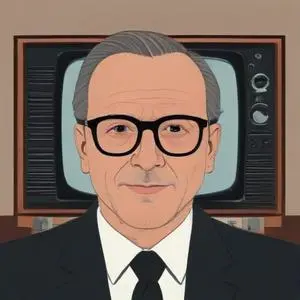
A pioneering media theorist who coined the phrase "the medium is the message," exploring how technology shapes human culture and communication.
Marshall McLuhan is widely regarded as the father of media studies, known for coining the expressions "the medium is the message" and "global village." His groundbreaking work predicted the advent of the World Wide Web almost three decades before its invention, cementing his status as a visionary thinker.
McLuhan was born on July 21, 1911, in Edmonton, Alberta, Canada, to Elsie Naomi and Herbert Ernest McLuhan. He grew up in Winnipeg, Manitoba, and attended the University of Manitoba, where he initially pursued engineering before switching to English literature. He later earned his Ph.D. from the University of Cambridge in 1943.
McLuhan began his teaching career as a professor of English at several universities in the United States and Canada. In 1946, he joined the University of Toronto, where he remained for the rest of his life. During this period, he developed his theories on media and communication, which would later become the backbone of modern media studies.
McLuhan's work revolves around the concept that the medium itself, rather than the content it carries, is the primary driver of social change. He argued that each medium, from print to radio to television, has its own unique characteristics that shape human perception and behavior. His book, Understanding Media: The Extensions of Man, published in 1964, is considered a seminal work in the field of media theory.
In addition to "the medium is the message," McLuhan is also known for his concept of the "global village," which predicted the emergence of a global community connected through electronic media. He also explored the idea of "hot" and "cool" media, categorizing media into those that require high participation (hot) and those that require low participation (cool).
McLuhan's ideas have had a profound impact on modern society, influencing fields such as education, advertising, and mass communication. His work has also inspired numerous artists, writers, and thinkers, including celebrated figures like Andy Warhol and John Lennon.
In the 1960s, McLuhan became a fixture in media discourse, appearing on television shows and writing articles for prominent publications. However, his influence began to wane in the early 1970s, only to experience a resurgence with the advent of the Internet and the World Wide Web in the 1990s.
McLuhan's ideas have not been without controversy. Critics have accused him of being overly pessimistic about the effects of technology on society, and some have dismissed his theories as too abstract or vague. Despite these criticisms, McLuhan's work remains a cornerstone of media studies, continuing to inspire new generations of scholars and thinkers.
McLuhan married Corinne Lewis in 1939, and the couple had six children together. He died on December 31, 1980, leaving behind a legacy as one of the most influential thinkers of the 20th century.
In conclusion, Marshall McLuhan's groundbreaking work on media theory has had a lasting impact on our understanding of communication and technology. His ideas continue to inspire and provoke, ensuring his legacy as a visionary thinker and a prophet of the modern age.
"The medium is the message."
"Global village."
"The new electronic interdependence recreates the world in the image of a global village."
95 Years Old
A renowned author and social critic who critiqued the effects of technology on society, warning about the dangers of a culture obsessed with entertainment and lacking in critical thinking.
97 Years Old
A French sociologist and philosopher who developed theories on consumerism, hyperreality, and the simulation of reality, arguing that our postmodern world is more concerned with images and appearances than reality itself.
94 Years Old
A renowned Italian intellectual who wrote bestselling novels like "The Name of the Rose" and "Foucault's Pendulum", blending mystery, history, and philosophy, while also being a prominent literary critic and philosopher.
97 Years Old
Developed groundbreaking theories on language acquisition and universal grammar, and is a prominent critic of power and propaganda in modern society.
Born in 1898
A critical theorist who challenged traditional notions of freedom, democracy, and consumerism, arguing that modern society is oppressive and dehumanizing.
Born in 1903
A critical theorist who critiqued modern society, culture, and capitalism, arguing that they perpetuate inequality and stifle individual freedom. His work influenced many fields, from sociology to musicology.
Born in 1892
A German philosopher and critic who analyzed the impact of technology on society, particularly in regards to art and culture, and is famous for his concept of "aura" in the age of mechanical reproduction.
94 Years Old
A French theorist and author who developed the concept of "spectacle," arguing that modern society is shaped by the consumption of images and commodities, leading to a loss of authentic human experience.
