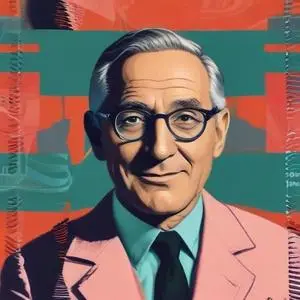
Marshall Warren Nirenberg: The Pioneer of Genetic Code Deciphering
The Breakthrough Discovery
Marshall Warren Nirenberg is renowned for his groundbreaking contribution to the field of biochemistry and genetics, wherein he deciphered the genetic code, elucidating the mechanism by which DNA instructions are translated into proteins. In 1968, Nirenberg was awarded the Nobel Prize in Physiology or Medicine, alongside
Har Gobind Khorana and
Robert W. Holley, for his pioneering work in cracking the genetic code.
Early Life and Education
Born on April 10, 1927, in New York City to a Jewish family, Nirenberg's early life was marked by a penchant for biology. Following a bout of rheumatic fever, his family relocated to Orlando, Florida, where he developed a deep interest in the natural world. Nirenberg pursued his higher education at the University of Florida, Gainesville, earning a BS degree in 1948 and a master's degree in zoology in 1952. His master's thesis, an ecological and taxonomic study of caddis flies (Trichoptera), demonstrated his early fascination with the intricacies of biological systems.
Academic Pursuits and Research Career
Nirenberg's academic trajectory continued at the University of Michigan, Ann Arbor, where he earned his PhD in biochemistry in 1957. Under the guidance of James F. Hogg, he investigated hexose uptake in tumor cells. Subsequently, he joined the National Institutes of Health (NIH) as a postdoctoral fellow of the American Cancer Society, eventually becoming a research biochemist in 1959. At the NIH, Nirenberg dedicated himself to studying the complex relationships between DNA, RNA, and protein synthesis.
Achievements and Recognition
Nirenberg's seminal work led to numerous accolades, including the Louisa Gross Horwitz Prize from Columbia University in 1968, which he shared with Har Gobind Khorana. His Nobel Prize in Physiology or Medicine in 1968 cemented his status as a pioneer in the field of genetic research. Throughout his career, Nirenberg held various leadership positions, including the head of the Section of Biochemical Genetics in the National Heart Institute (now the National Heart, Lung, and Blood Institute).
Personal Life and Relationships
Nirenberg married Perola Zaltzman, a chemist from the University of Brazil, Rio de Janeiro, in 1961. The couple shared a deep bond, both personally and professionally, as Perola also worked at the NIH. Their 40-year marriage ended with Perola's passing in 2001.
Legacy and Impact
Marshall Warren Nirenberg's groundbreaking research has had a profound impact on our understanding of genetic code and protein synthesis. His work has paved the way for significant advances in molecular biology, leading to the development of novel therapeutic strategies and diagnostic tools. As a testament to his enduring influence, Nirenberg's legacy continues to inspire future generations of scientists and researchers.
Timeline of Major Milestones
- 1927: Born on April 10th in New York City
- 1948: Earned BS degree from the University of Florida, Gainesville
- 1952: Received master's degree in zoology from the University of Florida, Gainesville
- 1957: Earned PhD in biochemistry from the University of Michigan, Ann Arbor
- 1957: Began postdoctoral work at the National Institutes of Health (NIH)
- 1959: Became a research biochemist at the NIH
- 1961: Married Perola Zaltzman
- 1962: Became the head of the Section of Biochemical Genetics in the National Heart Institute
- 1968: Awarded the Nobel Prize in Physiology or Medicine
- 1968: Received the Louisa Gross Horwitz Prize from Columbia University
- 2001: Perola Zaltzman passed away
- 2010: Passed away on January 15th
FAQ
What was Marshall Warren Nirenbergs profession?
Marshall Warren Nirenberg was an American biochemist and geneticist, who made groundbreaking contributions to the field of molecular biology.
What was Marshall Warren Nirenbergs most notable discovery?
Nirenberg is most famous for cracking the genetic code, deciphering the sequence of nucleotides that correspond to specific amino acids and enabling the understanding of protein synthesis.
What awards did Marshall Warren Nirenberg receive for his work?
Nirenberg was awarded the Nobel Prize in Physiology or Medicine in 1968, along with Har Gobind Khorana and Robert W. Holley, for his pioneering work on the genetic code.
How did Marshall Warren Nirenbergs work impact the scientific community?
Nirenbergs discovery revolutionized the field of molecular biology, enabling significant advances in genetics, genomics, and biotechnology, and paving the way for future breakthroughs in these areas.
Is Marshall Warren Nirenberg still remembered by the scientific community?
Yes, Nirenberg is still celebrated by the scientific community, who recognize his immense contributions to our understanding of the genetic code and his lasting impact on the development of molecular biology.