


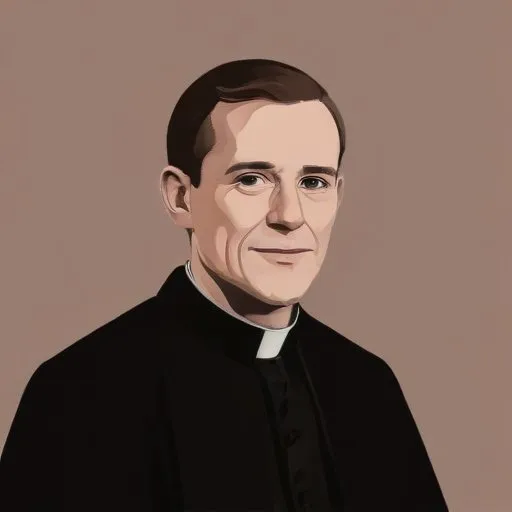
A Jesuit priest and philosopher who wrote extensively on theology, philosophy, and literature, making significant contributions to Catholic intellectual thought.
Martin DArcy, a renowned English Jesuit priest, philosopher, and correspondent, left an indelible mark on the literary and artistic world of the 20th century. He is best known for his profound philosophical works, particularly "The Mind and Heart of Love," which delved into the intricate relationship between eros and agape love.
DArcy was born on June 15, 1888, in Bath, Somerset, to Martin Valentine DArcy and Madoline Mary Keegan. He was the youngest of four sons. He received his education at Stonyhurst, Oxford, and later at the Gregorian University in Rome.
DArcy entered the Society of Jesus in 1907 and was ordained as a priest in 1921. He spent most of his working life at Campion Hall, the English Jesuit house in Oxford, where he engaged in intense philosophical and theological pursuits. His scholarly endeavors took him to various American universities, including Georgetown, Gonzaga, Cornell, and the Institute for Advanced Study in Princeton, New Jersey.
DArcy's remarkable ability to connect with literary and artistic figures led to the conversion of many notable individuals, including the German-Jewish Baroness Vera von der Heydt. His circle of friends and acquaintances included luminaries such as Evelyn Waugh, Dorothy L. Sayers, W. H. Auden, Eric Gill, and Sir Edwin Lutyens.
DArcy's magnum opus, "The Mind and Heart of Love," published in 1945, is a seminal work that explores the intricate theological relationship between eros and agape love. This work, published by T. S. Eliot at Faber and Faber, has been widely acclaimed for its profound insights and erudite scholarship.
Martin DArcy passed away on November 20, 1976, at the Hospital of St John and St Elizabeth in London. He is buried in St. Mary's Roman Catholic Cemetery, Kensal Green. A permanent collection at the Loyola University Museum of Art is named in his memory, a testament to his enduring impact on the world of art and literature.
His grave, marked with a shared granite marker, bears a poignant inscription, a fitting tribute to a life devoted to illuminating the path of love and understanding.
Born in 1876
The leader of the Catholic Church from 1939 to 1958, known for his controversial role during World War II, particularly in regards to the Holocaust. He is also remembered for his encyclicals on social justice and liturgical reforms.
Born in 1921
A Catholic priest who wrote poetry and protested war and nuclear proliferation through nonviolent civil disobedience, inspiring a generation of activists.
Born in 1915
A Trappist monk and writer who explored spirituality and social justice through his poetry and essays, leaving a lasting impact on Christian mysticism and contemplative thought.
Born in 1881
A French priest who merged spirituality with science, exploring the intersection of faith and evolution, and proposing a cosmic vision of human destiny. He's famous for his book "The Phenomenon of Man".
Born in 1904
A German priest and theologian who sought to reconcile Catholicism with modern philosophy, exploring the intersection of faith and reason. His work greatly influenced 20th-century Catholic theology.
