


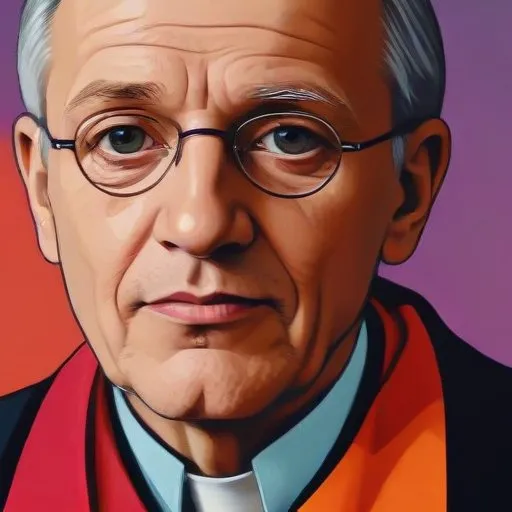
A 16th-century Catholic theologian who fiercely opposed the Protestant Reformation, writing extensively against Luther and Calvin. His works significantly influenced the Counter-Reformation.
Martin Eisengrein, a renowned German Catholic theologian, university professor, and polemical writer, left an indelible mark on the Catholic Reformation. He is best known for his eloquent defenses of Catholic doctrine, particularly his advocacy for the cult of the saints and pilgrimage, which played a crucial role in shaping the Counter-Reformation.
Born on December 28, 1535, in Stuttgart, Eisengrein was the son of Lutheran parents, Martin and Anna Kienzer Eisengrein. He received his early education at the Latin school of Stuttgart, where he developed a strong foundation in the humanities. Eisengrein's academic pursuits continued at the University of Tübingen, where he studied liberal arts and philosophy.
In 1553, Eisengrein enrolled at the University of Ingolstadt to study jurisprudence, fulfilling his father's wishes. However, his intellectual curiosity soon led him to the University of Vienna, where he earned his Master of Arts degree in May 1554. During his time in Vienna, Eisengrein was exposed to Catholicism, which would eventually become the catalyst for his conversion.
Under the tolerant rule of Ferdinand I, Eisengrein became a professor of oratory and physics at the University of Vienna, a Catholic institution. It was during this period that he was influenced by his uncle, Imperial Vice Chancellor Jakob of Jonas, and frequent interactions with Jesuits, which ultimately led to his acceptance of the Catholic faith in 1558.
In 1559, Eisengrein received a canonry at St. Stephen's in Vienna and was ordained priest the following year. His academic career flourished as he became professor of theology at the University of Ingolstadt in 1562. Concurrently, he served as pastor of the church of St. Moritz, which was affiliated with the university. Eisengrein's tenure as rector of the university began in April 1562, during which he promoted the celebration of the Feast of Corpus Christi.
One of Eisengrein's most significant contributions was his defense of the cult of the saints and pilgrimage. His sermon, "A Christian Sermon Concerning the Reasons Shrines Are Held in Such High Esteem in the Catholic Church," published in 1563, was a landmark work in the Counter-Reformation. This publication solidified his position as a key figure in the Catholic Reformation, advocating for the importance of venerating saints and sacred sites.
Martin Eisengrein's tireless efforts to promote Catholic doctrine and his eloquent defenses of the faith have left a lasting impact on the Catholic Church. His contributions to the Counter-Reformation, particularly his advocacy for the cult of the saints and pilgrimage, continue to inspire and influence Catholic theologians and scholars to this day.
In conclusion, Martin Eisengrein's remarkable life and achievements serve as a testament to the power of faith, intellectual curiosity, and dedication to the Catholic Church. His legacy continues to inspire and educate generations of Catholics and scholars alike.
Born in 1469
A 16th-century Dominican friar and theologian, he played a key role in the Catholic Counter-Reformation, engaging in debates with Protestant reformers like Martin Luther. He's known for his commentaries on Aristotle and Aquinas.
Born in 1478
A renowned Renaissance humanist and statesman who served as Lord Chancellor of England, famous for his literary work "Utopia" and his martyrdom for refusing to acknowledge the English monarch's supremacy over the Church.
Born in 1483
A German monk and priest who sparked the Protestant Reformation, challenging Catholic Church authority and shaping Western Christianity. He's famous for nailing 95 theses to a church door, sparking a religious revolution.
Born in 1484
Leader of the Swiss Reformation, advocating for church reform and inspiring other Protestant movements.
Born in 1509
A French pastor and theologian who played a key role in the Protestant Reformation, shaping Christian theology and influencing Western civilization. He's famous for his teachings on predestination and his role in establishing Calvinism.
Born in 1497
A 16th-century Renaissance scholar who made significant contributions to the development of the Protestant Reformation and education, known for his theological writings and astronomical observations.
