


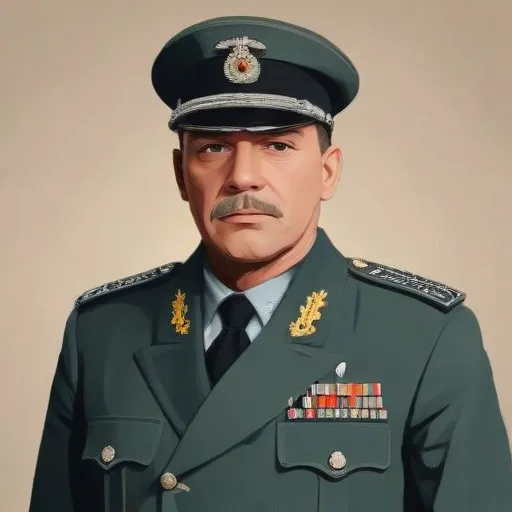
A high-ranking Nazi officer and lawyer who played a key role in the Holocaust, responsible for the extermination of thousands of Jews during World War II.
Martin Sandberger, born on August 17, 1911, in Charlottenburg, Berlin, is notoriously known as the commander of Sonderkommando 1a of Einsatzgruppe A, responsible for the mass murder of Jews in German-occupied Latvia and Estonia during World War II. His sinister activities also extended to the arrest of Jews in Italy, resulting in their deportation to the Auschwitz concentration camp.
Sandberger was born into a prominent family, with his father being a director of IG Farben. He pursued law studies at the Universities of München, Kln, Freiburg, and Tbingen. At the age of 20, he joined the Nazi Party and the SA, demonstrating his early allegiance to the Nazi ideology.
By 1938, Sandberger had risen to the rank of SS Sturmbannfhrer (major) and worked as an assistant judge in the Interior Administration of Wrttemberg, subsequently becoming a government councillor in 1937. His involvement in the SD and his rapid ascent in the Nazi ranks paved the way for his future war crimes.
During World War II, Sandberger's brutal actions as the commander of Sonderkommando 1a earned him a notorious reputation. He was responsible for the massacre of thousands of Jews in Latvia and Estonia, solidifying his position as a convicted Holocaust perpetrator.
Sandberger was the second-highest official of the Einsatzgruppe A to be tried and convicted. His trial was part of the Nuremberg Military Tribunals, where he was held accountable for his heinous crimes. He was the last surviving defendant from the Nuremberg Military Tribunals, serving as a grim reminder of the atrocities committed during the Nazi era.
Martin Sandberger's life is a testament to the horrors of the Nazi regime. His actions, which resulted in the senseless murder of countless innocent lives, will forever be etched in the annals of history as a shameful reminder of humanity's darkest hour. Sandberger's conviction serves as a warning to future generations, emphasizing the importance of accountability and the need to confront and condemn such atrocities.
Born in 1889
The dictator of Nazi Germany, responsible for the genocide of six million Jews and millions of other people during World War II, and infamous for his extreme nationalist and anti-Semitic ideology.
Born in 1900
Leading the SS and Gestapo, he oversaw the Nazi regime's brutal security apparatus and implemented the "Final Solution," orchestrating the genocide of six million Jews during World War II.
Born in 1904
A high-ranking Nazi official and chief architect of the Holocaust, responsible for implementing the "Final Solution" that led to the murder of six million Jews and millions of others during World War II.
Born in 1903
Austrian-German lawyer and general who served as the highest-ranking leader of the Nazi police forces, responsible for overseeing the Gestapo, SS, and concentration camps during World War II. He was a key figure in the Holocaust and other atrocities committed by the Nazi regime.
Born in 1876
A German naval leader who played a key role in the Kriegsmarine during World War II, overseeing the German U-boat fleet and naval operations. He was a close advisor to Adolf Hitler and implemented the German naval strategy during the war.
Born in 1882
A high-ranking Nazi officer who served as the Chief of the OKW, the German High Command, during World War II, and was known for his unwavering loyalty to Hitler. He was tried and executed for war crimes after the war.
Born in 1890
Chief of the German High Command during World War II, responsible for planning and executing military operations, and signing the unconditional surrender of Germany.
Born in 1893
A German diplomat who served as the Nazi regime's Foreign Minister, orchestrating key alliances and treaties that led to World War II. He was a close associate of Adolf Hitler and played a crucial role in shaping Nazi foreign policy.
