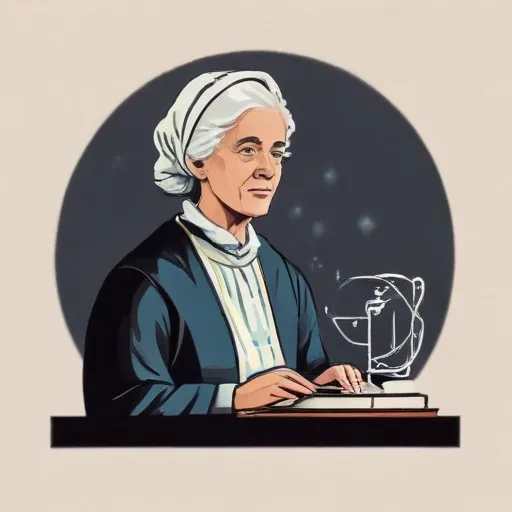
Mary Acworth Evershed: Unveiling the Celestial Secrets of Dante's Poems
A Life of Stargazing and Literary Pursuits
Mary Acworth Evershed, a British astronomer and scholar, is renowned for her groundbreaking work on the astronomical references in Dante Alighieri's poems. Under the pen name M.A. Orr, she delved into the world of literature and astronomy, leaving an indelible mark on both fields.
Born on January 1, 1867, in Plymouth Hoe, England, Mary grew up with a passion for learning. Her early life was marked by travel, and it was during a trip to Florence (1888-1890) that she discovered her fascination with Dante's works. This sparked a lifelong interest in the astronomical allusions within his poetry.
Astrophilic Inspiration in Australia
In 1890, Mary moved to Australia with her family and began writing An Easy Guide to the Southern Stars, encouraged by John Tebbutt, the leading astronomer in Australia at the time. This book was a pioneering effort, as it addressed the lack of guides to the southern stars.
Meetings, Mentorships, and Marriage
Mary's work took her to Norway in 1896, where she participated in an expedition to view a total solar eclipse. Here, she met fellow British astronomer John Evershed, whom she later married in 1906. Their union marked the beginning of a new chapter in her life, as John took up a post as assistant astronomer at Kodaikanal Observatory in India.
Traversing the Globe, Collecting Celestial Insights
The Eversheds' journey to India was punctuated by visits to notable astronomical locations in the United States. Mary's travels allowed her to collect plants from the region, which were eventually deposited in the British Museum. Her experiences in India deeply influenced her work, as she continued to explore the connections between literature and astronomy.
Friendships and Mentors
Mary's membership in the British Astronomical Association (BAA) introduced her to a circle of intellectual women, including Agnes Clerke and Annie Scott Dill Maunder. These friendships proved invaluable, as they provided a support system and encouraged her to pursue her interests in historical astronomy.
Legacy and Impact
Mary Acworth Evershed's work has left an indelible mark on the world of astronomy and literary studies. Her pioneering efforts paved the way for future generations of women in science and herresearch continues to inspire new discoveries. As we gaze up at the celestial canvas, we are reminded of Mary's remarkable journey, one that bridged the gap between art and science.
Major Works and Contributions
- An Easy Guide to the Southern Stars (1890)
- Research on astronomical references in Dante Alighieri's poems
- Membership in the British Astronomical Association (BAA)
Personal Milestones and Key Life Events
- Travels to Florence (1888-1890), Australia (1890-1895), and India (1907)
- Marriage to John Evershed (1906)
A Lasting Legacy: Mary Acworth Evershed's Enduring Impact
Mary Acworth Evershed's extraordinary life serves as a testament to the power of curiosity and determination. As we reflect on her remarkable journey, we are reminded that the boundaries of art and science are meant to be pushed, and that the secrets of the universe are waiting to be unveiled.
FAQ
What were Mary Acworth Eversheds contributions to astronomy?
Mary Acworth Evershed made significant contributions to astronomy, including her work on sunspots and solar cycles. She was one of the first women to study astronomy and was a pioneer in the field.
What awards did Mary Acworth Evershed receive for her work in astronomy?
Mary Acworth Evershed received several awards for her work in astronomy, including the Annie Jump Cannon Award in 1925. She was also a fellow of the Royal Astronomical Society.
How did Mary Acworth Eversheds work impact the field of astronomy?
Mary Acworth Eversheds work had a significant impact on the field of astronomy, particularly in the study of sunspots and solar cycles. Her research paved the way for future generations of astronomers.
What was Mary Acworth Eversheds educational background?
Mary Acworth Evershed studied at Newnham College, Cambridge, where she earned a degree in mathematics. She later went on to study astronomy at the University of London.
What were Mary Acworth Eversheds interests outside of astronomy?
Mary Acworth Evershed was not only interested in astronomy but also in literature and music. She was known to be an accomplished pianist and enjoyed reading classical literature.