


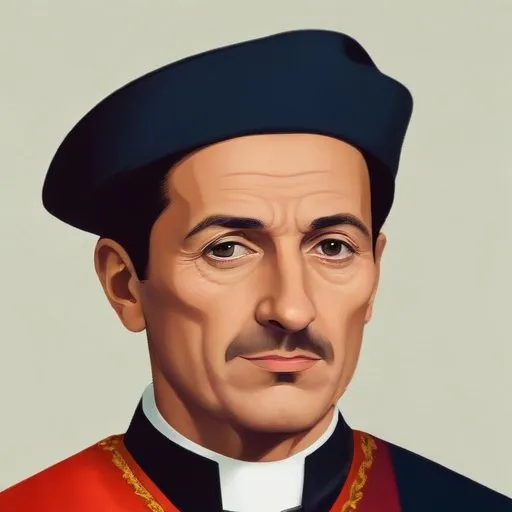
A 16th-century Italian statesman and jurist who served as a chief advisor to Emperor Charles V, playing a key role in shaping the Holy Roman Empire's policies and governance. He's also known for his contributions to the development of modern diplomacy and international law.
Mercurino Gattinara, a 16th-century Italian diplomat, philosopher, and polymath, is best known for his influential role as the Grand Chancellor of the Duchy of Milan and his significant contributions to the development of modern diplomacy. As a key advisor to Charles V, Holy Roman Emperor, Gattinara played a pivotal role in shaping European politics and fostering alliances that would have a lasting impact on the continent.
Born in 1465 in Vercelli, Italy, Gattinara was raised in a family of modest means, but his intellectual curiosity and ambition drove him to pursue higher education. He studied law and philosophy at the University of Turin, where he developed a deep understanding of classical antiquity and humanist thought.
Gattinara's diplomatic career began in the early 16th century, when he served as an envoy for the Duchy of Milan. His exceptional negotiation skills, linguistic proficiency, and strategic thinking quickly earned him recognition and respect among European leaders. In 1519, he was appointed Grand Chancellor of Milan, a position that granted him significant influence over the duchy's foreign policy.
Gattinara was not only a skilled diplomat but also a prolific writer and philosopher. He authored several treatises on politics, ethics, and philosophy, showcasing his profound understanding of classical thought and his own humanist perspectives. His works, particularly De Regime Principum, offered insightful reflections on the nature of power, governance, and the role of the ideal ruler.
Gattinara's innovative approach to diplomacy, which emphasized the importance of negotiation, compromise, and mutual understanding, laid the groundwork for modern diplomatic practices. His tireless efforts to promote peace and stability in Europe earned him the respect of his contemporaries and left a lasting legacy in the world of diplomacy.
Gattinara's personal life was marked by his dedication to his duties as a diplomat and his unwavering commitment to his ideals. Despite facing numerous challenges and setbacks, he remained steadfast in his pursuit of peace and stability in Europe.
Gattinara's life and work were deeply embedded in the complex web of Renaissance politics and culture. His contributions to diplomacy, philosophy, and humanism continue to inspire scholars and diplomats alike, offering valuable insights into the intricacies of international relations and the importance of cooperation.
"A diplomat must be like a river, able to flow and adapt to the changing tides of politics."
Gattinara's remarkable life and achievements serve as a testament to the power of diplomacy, intellectual curiosity, and unwavering dedication to the pursuit of peace and understanding.
Born in 1500
Ruling over a vast empire from 1519 to 1556, he was a powerful and influential leader who played a crucial role in shaping European politics and religion. He is most known for his efforts to unify Christian Europe and defend it against the Ottoman Empire.
Born in 1536
Led the Catholic Church during a tumultuous period, issuing papal bulls and playing a key role in the Counter-Reformation. He's also famous for his coffee habit, being the first Pope to try and approve of it.
Born in 1491
A larger-than-life monarch who ruled England with an iron fist, infamous for his six marriages and the English Reformation.
Born in 1469
Italian historian and philosopher who wrote "The Prince", a seminal work on politics and power that still influences modern leadership and governance today.
Born in 1478
A renowned Renaissance humanist and statesman who served as Lord Chancellor of England, famous for his literary work "Utopia" and his martyrdom for refusing to acknowledge the English monarch's supremacy over the Church.
Born in 1449
Renaissance leader who ruled Florence and sponsored artists like Michelangelo and Botticelli, shaping the city's cultural and artistic heritage.
Born in 1535
The second shortest-reigning pope in history, serving for just 27 days in 1605, he is most known for his brief but tumultuous papacy marked by power struggles and controversy.
