


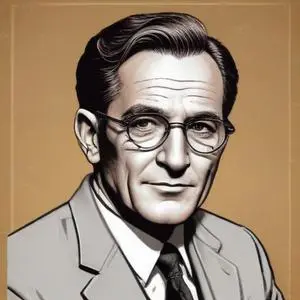
Pioneering historian and author who reshaped the field of American social and intellectual history through his groundbreaking works, earning a Pulitzer Prize in 1944.
Merle Curti, a renowned American progressive historian, left an indelible mark on the fields of peace studies, intellectual history, and social history. He is celebrated for his groundbreaking work in utilizing cliometrics, quantitative tools, to analyze historical data and shed light on the complex dynamics of human societies.
Born on September 15, 1897, in Papillion, Nebraska, Curti's intellectual curiosity and passion for democracy were instilled in him from a young age. His parents, John Eugene Curti and Alice Hunt, encouraged his love for learning, which would eventually take him to the hallowed halls of Harvard University.
Curti's academic prowess was evident early on, as he graduated summa cum laude from Harvard in 1920. He then spent a year in France, where he met his future wife, Margaret Wooster, a pioneer in child psychology research. The couple married in 1925 and had two daughters together.
Curti's academic career spanned several decades, during which he taught at esteemed institutions such as Smith College, Beloit College, and Columbia University. However, it was his 25-year tenure at the University of Wisconsin that cemented his reputation as a visionary historian.
He directed an impressive 86 Ph.D. dissertations, leaving an enduring legacy in the world of academia. Curti's commitment to democracy and his Turnerian thesis, which posits that social and economic forces shape American life, thought, and character, continue to influence scholars to this day.
Curti's pioneering work in peace studies is a testament to his dedication to promoting global harmony. His book, The American Peace Crusade, 1815–1860 (1929), was a seminal work that explored the roots of American pacifism.
He went on to publish several influential books, including Bryan and World Peace (1931), which examined the role of William Jennings Bryan in promoting international peace. Curti's work in peace studies paved the way for future generations of scholars, policymakers, and activists.
Curti's contributions to the field of history and peace studies were recognized with several awards and honors. He was a fellow of the American Academy of Arts and Sciences and received the prestigious Theodore E. Burton Award from the American Historical Association.
Merle Curti's legacy extends far beyond the realm of academia. His work has inspired countless individuals to strive for a more peaceful and just world. As a committed democrat, he believed in the power of education to shape a better future.
As we reflect on Curti's remarkable life and achievements, we are reminded of the importance of promoting democracy, understanding, and global cooperation. His intellectual legacy continues to inspire new generations of scholars, policymakers, and citizens to work towards a more harmonious world.
Merle Curti's remarkable life serves as a testament to the power of scholarship, dedication, and a commitment to creating a better world for all.
Born in 1861
Pioneering historian who coined the "Frontier Thesis," arguing that the American West's vast open spaces shaped the country's unique identity and democratic values.
Born in 1874
A pioneering historian and educator who co-founded The New School, shaping modern historical thought and education. Known for his influential writings on American history and politics.
Born in 1916
A Pulitzer Prize-winning historian and academic who wrote influential books on American history, politics, and culture, shaping the way we understand our nation's past and present.
Born in 1908
A renowned historian and author who wrote extensively on the American South, shedding light on its complex history and racial dynamics. His works remain influential in understanding the region's past and its ongoing impact on modern society.
Born in 1915
Pioneering historian and Pulitzer Prize winner who illuminated the American immigrant experience through groundbreaking research and writings.
