


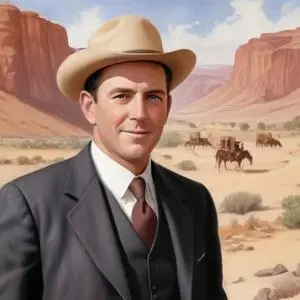
Pioneering historian who coined the "Frontier Thesis," arguing that the American West's vast open spaces shaped the country's unique identity and democratic values.
Frederick Jackson Turner, a renowned American historian, is best known for his groundbreaking "frontier thesis," which revolutionized the understanding of American history and democracy. His seminal work, "The Significance of the Frontier in American History," argued that the moving western frontier exerted a profound influence on American democracy and the American character from the colonial era until 1890.
Turner was born on November 14, 1861, in Portage, Wisconsin, to Andrew Jackson Turner and Mary Olivia Hanford Turner. His father was an investor in a railroad, newspaper editor, and publisher, while his mother taught school. Growing up in a middle-class family, Turner was deeply influenced by the writings of Ralph Waldo Emerson and scientists like Charles Darwin, Herbert Spencer, and Julian Huxley.
In 1884, Turner graduated from the University of Wisconsin (later renamed the University of Wisconsin-Madison), where he was a member of the Phi Kappa Psi Fraternity. He went on to earn his PhD in history from Johns Hopkins University in Baltimore in 1890, with a thesis on the fur trade in Wisconsin, titled "The Character and Influence of the Indian Trade in Wisconsin," under the supervision of Herbert Baxter Adams.
Turner's academic career spanned over four decades, during which he taught at the University of Wisconsin-Madison and Harvard University. He was a prolific writer and published numerous articles and books on American history, geography, and culture. His work emphasized the importance of interdisciplinary and quantitative methods, often focusing on the Midwestern United States.
Turner's most significant contribution was his "frontier thesis," which proposed that the American frontier played a crucial role in shaping American democracy, individualism, and character. This idea challenged traditional views of American history and sparked a new wave of historical scholarship.
Turner's work has had a profound impact on American historiography and continues to influence historical scholarship today. His students, who went on to become prominent historians, include notable figures like Merle Curti, Carl Becker, and Herbert Feis. Turner's emphasis on quantitative methods and interdisciplinary approaches paved the way for new areas of study, such as environmental history and cultural geography.
Despite criticisms and controversies surrounding his work, Turner's legacy as a pioneering historian remains unchallenged. His work continues to inspire new generations of scholars, researchers, and enthusiasts of American history.
"The frontier is the line of most rapid and effective Americanization." - Frederick Jackson Turner
Turner's work continues to be a testament to his dedication to understanding the complexities of American history and culture. His pioneering spirit and innovative approaches have left an indelible mark on the field of history.
Born in 1858
A pioneering leader who championed progressive reforms, trust-busting, and conservation, earning a Nobel Peace Prize for mediating the Russo-Japanese War. He's also famous for his rugged outdoorsmanship and "big stick" diplomacy.
Born in 1856
The 28th President of the United States, a Nobel Peace Prize winner, and a historian who played a key role in shaping international relations and global governance after World War I. He's most known for his idealistic vision of a League of Nations and his efforts to promote peace and diplomacy.
Born in 1878
A pioneering muckraker, exposing social and economic injustices through influential novels, most notably "The Jungle", which led to significant reforms in the meatpacking industry.
Born in 1870
Pioneering naturalist writer who explored the darker aspects of human nature and the American Dream through novels like "McTeague" and "The Octopus".
Born in 1896
A pioneering writer of the Lost Generation, known for experimental novels that capture the spirit of early 20th-century America, blending fiction and journalism.
Born in 1899
A legendary writer who crafted sparse, powerful prose, capturing the human experience in novels like "The Old Man and the Sea" and "A Farewell to Arms".
Born in 1896
Author of novels and short stories that capture the essence of the Jazz Age, exploring themes of wealth, class, and the American Dream. Known for timeless classics like "The Great Gatsby" and "Tender Is the Night".
Born in 1862
A pioneering female author of novels and short stories that explored the social conventions and morals of the Gilded Age, known for her witty and insightful portrayals of the American aristocracy.
