


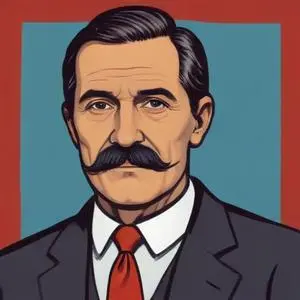
A pioneering historian and educator who co-founded The New School, shaping modern historical thought and education. Known for his influential writings on American history and politics.
Charles A. Beard is renowned for his groundbreaking work in American history, particularly his radical reevaluation of the Founding Fathers and their motivations. His seminal book, An Economic Interpretation of the Constitution of the United States (1913), sparked controversy and debate among historians, cementing his status as a leading figure in the progressive school of historical interpretation.
Beard was born on November 27, 1874, in Knightstown, Indiana, to a farming family. His father, William Henry Harrison Beard, was a farmer, contractor, part-time banker, and real estate speculator. Beard's early life was shaped by his experiences on the family farm and his education at Spiceland Academy, a local Quaker school. After being expelled from Spiceland, he graduated from Knightstown High School in 1891.
Beard's academic career began as a history professor at Columbia University, where he taught for over three decades. He authored numerous influential books, including:
His most iconic work, An Economic Interpretation of the Constitution of the United States, challenged the prevailing views of the Founding Fathers' motivations, arguing that economic interests drove their decisions rather than philosophical principles.
Beard's work was characterized by a commitment to progressive and democratic values. He believed that historians had a responsibility to provide a "usable past" that could inform and shape contemporary society. His emphasis on economic and social factors in historical events reflected his conviction that history should serve as a tool for social reform.
Beard's ideas had a significant impact on American historiography, influencing generations of historians and scholars. His work also shaped public discourse, informing policy debates and social movements. During the 1930s and 1940s, his critiques of corporate power and advocacy for social reform resonated with the New Deal era's progressive politics.
Beard married Mary Ritter in 1900, and the couple had two daughters. He was an active participant in progressive politics, supporting causes such as women's suffrage and labor rights. Throughout his life, he remained committed to his Quaker heritage, advocating for pacifism and international cooperation.
Beard's work was not without controversy. Critics accused him of being overly materialistic and neglecting the role of ideas in shaping American history. During the Cold War era, his reputation suffered as the assumption of economic class conflict fell out of favor among American historians. However, his legacy as a towering figure in American historiography remains unchallenged.
Richard Hofstadter, a prominent historian, aptly described Beard's legacy: "What was once the grandest house in the province is now a ravaged survival." Despite criticisms and fluctuations in his reputation, Beard's influence on American historical thought endures. His commitment to a "usable past" continues to inspire scholars and inform public discourse.
Born in 1856
The 28th President of the United States, a Nobel Peace Prize winner, and a historian who played a key role in shaping international relations and global governance after World War I. He's most known for his idealistic vision of a League of Nations and his efforts to promote peace and diplomacy.
Born in 1858
A pioneering leader who championed progressive reforms, trust-busting, and conservation, earning a Nobel Peace Prize for mediating the Russo-Japanese War. He's also famous for his rugged outdoorsmanship and "big stick" diplomacy.
Born in 1882
Led the United States through the Great Depression and World War II, implementing a series of reforms known as the New Deal and helping to establish the country as a global superpower.
Born in 1889
Co-founder of The New Republic, a pioneering journalist and publisher who shaped American political discourse with his influential writings and opinions. He's most known for his insightful commentary on democracy, politics, and society.
Born in 1859
Developed pragmatic philosophy and progressive education theories, focusing on hands-on learning and social reform. Known for his influential ideas on democracy, education, and individual freedom.
Born in 1857
A pioneering economist and sociologist who coined the term "conspicuous consumption" to describe how people use luxury goods to showcase their social status, and is known for his critical views on capitalism.
Born in 1878
A pioneering muckraker, exposing social and economic injustices through influential novels, most notably "The Jungle", which led to significant reforms in the meatpacking industry.
Born in 1855
A pioneering labor leader who fought for workers' rights and social justice, founding the Industrial Workers of the World and running for president five times on the Socialist Party ticket.
