


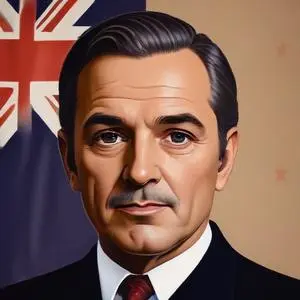
A pioneering politician who championed social welfare and unity, leading New Zealand through the Great Depression and World War II, implementing groundbreaking reforms and earning a revered legacy.
Michael Joseph Savage, New Zealand's 23rd prime minister, led the country's first Labour Government from 1935 until his death in 1940, leaving an indelible mark on the nation's social welfare system. He is revered as the architect of New Zealand's welfare state, a testament to his tireless efforts to improve the lives of ordinary Kiwis.
Born on March 23, 1872, in Tatong, Victoria, Australia, Savage was the youngest of eight children to Irish immigrant parents. He emigrated to New Zealand in 1907, at the age of 35, where he worked as a labourer and soon became involved in the trade union movement.
In 1910, Savage was elected president of the Auckland Trades and Labour Council, and by 1916, he actively supported the formation of the New Zealand Labour Party. His dedication to the labour movement earned him a seat in the House of Representatives in 1919, as one of eight Labour members returned in that election.
Savage's leadership skills and commitment to social justice propelled him to the forefront of the Labour Party. In 1933, he was elected unopposed as the party leader, paving the way for his historic victory in the 1935 election.
Under Savage's leadership, the Labour Party implemented a range of economic recovery policies and social welfare programmes, including the establishment of a universal superannuation scheme, which won him widespread public support.
Savage's government achieved unprecedented success in the 1938 election, and he is credited with creating New Zealand's welfare state. He is the only New Zealand prime minister to serve under three monarchs: George V, Edward VIII, and George VI.
Academics and the general public alike regard Savage as one of New Zealand's greatest and most revered prime ministers. His contributions to the country's social and economic development have left a lasting impact on modern society.
"I am not a leader, I am a spokesman on behalf of my party."
Savage's welfare state model has influenced generations of policymakers in New Zealand and beyond. His commitment to social justice and equality continues to inspire leaders and citizens alike.
Today, New Zealand remains a beacon of social and economic progress, thanks in no small part to Michael Joseph Savage's pioneering spirit and unwavering dedication to the welfare of its people.
Savage's leadership during the Great Depression and World War II cemented his place in New Zealand's history. His government's response to the economic crisis and its efforts to protect the country's sovereignty during wartime have become a benchmark for future generations.
As a champion of social justice and equality, Savage's legacy continues to inspire and inform policy decisions in New Zealand and around the world.
Born in 1884
Scottish-New Zealand journalist and politician who served as the 24th Prime Minister of New Zealand, leading the country through significant social and economic reforms. He's known for his progressive policies and strong leadership during wartime.
Born in 1893
Led the country through a period of significant economic growth and social change, implementing policies that shaped modern New Zealand. He's remembered for his strong leadership and nation-building efforts.
Born in 1904
A farmer-turned-politician who served as Prime Minister of New Zealand, known for his leadership during a period of significant economic and social change. He's remembered for his pragmatic and consensus-driven approach to governance.
Born in 1882
A lawyer-turned-politician who served as New Zealand's Prime Minister, implementing significant economic and social reforms, including the establishment of the country's welfare state.
74 Years Old
A renowned cancer researcher and professor who made significant contributions to the understanding and treatment of cancer, particularly in the field of p53 tumor suppressor gene.
91 Years Old
The 35th Prime Minister of New Zealand, serving from 1990 to 1997, known for leading the country through significant economic reforms and free trade agreements. He's also recognized for his role in shaping New Zealand's modern economy.
74 Years Old
The first female Prime Minister of New Zealand, serving from 1997 to 1999, known for her conservative economic policies and reform efforts. She played a significant role in shaping the country's social and economic landscape.
76 Years Old
The first female Prime Minister of New Zealand, serving three consecutive terms from 1999 to 2008, known for her progressive policies and commitment to social justice.
