


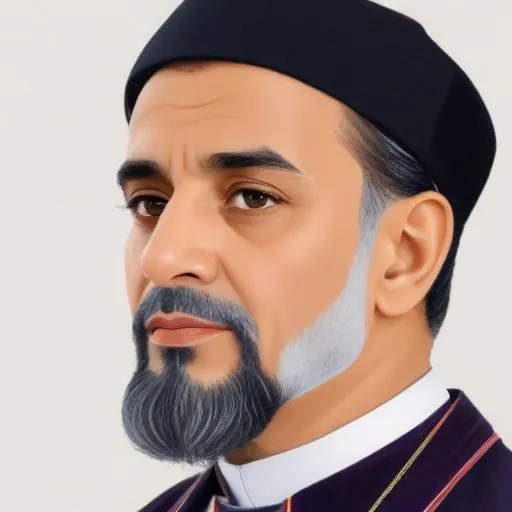
A Pakistani-born Anglican bishop who served as the Bishop of Rochester and was the first non-white diocesan bishop in the Church of England, known for his conservative views on social issues.
Michael Nazir-Ali, a British-Pakistani priest, is renowned for his remarkable journey as the 106th Bishop of Rochester from 1994 to 2009, and his subsequent conversion to Catholicism in 2021. He is also recognized for his extensive academic career, spanning multiple disciplines, including economics, Islamic history, sociology, and theology.
Born on August 19, 1949, in Karachi, Pakistan, to James and Patience Nazir-Ali, Michael's family background is a unique blend of Christian and Muslim heritage. His father, a Shia Muslim, converted to Christianity, and Michael began identifying as a Christian at the age of 15. He attended St. Paul's School and St. Patrick's College in Karachi, where he was exposed to Roman Catholicism.
Michael's academic pursuits took him to the University of Karachi, where he earned a BA in economics, Islamic history, and sociology in 1970. He later studied at Ridley Hall, Cambridge, in preparation for ordination, and pursued postgraduate studies in theology at St. Edmund Hall, Oxford, and Fitzwilliam College, Cambridge.
Nazir-Ali's academic interests are diverse and impressive, encompassing comparative literature and philosophy of religion. He has taught at various colleges and universities, and has been affiliated with institutions such as the Center for the Study of World Religions at Harvard Divinity School. In 2005, he was awarded the Lambeth DD, a prestigious honor bestowed by the Archbishop of Canterbury.
Michael Nazir-Ali's ecclesiastical career is marked by his service as Bishop of Raiwind in Pakistan and later as the Bishop of Rochester from 1994 to 2009. In 2021, he made the significant decision to convert to Catholicism, joining the Ordinariate of Our Lady of Walsingham, one of several Anglican bishops to do so that year. In 2022, he was conferred the title of Monsignor.
Today, Michael Nazir-Ali serves as the director of the Oxford Centre for Training, Research, Advocacy, and Dialogue, where he continues to promote interfaith dialogue and understanding. His remarkable life's work has left an indelible mark on the world of faith, academia, and beyond.
As a priest, scholar, and leader, Michael Nazir-Ali's profound impact on modern society is undeniable. His commitment to interfaith dialogue, education, and social justice has inspired countless individuals, and his legacy will continue to shape the course of faith and scholarship for generations to come.
76 Years Old
A former Archbishop of Canterbury and prominent theologian, known for his progressive views on social issues and his efforts to promote interfaith dialogue.
90 Years Old
A prominent leader of the Church of England, serving as Archbishop of Canterbury from 1991 to 2002, known for his efforts to modernize the church and promote interfaith dialogue.
Born in 1921
The 102nd Archbishop of Canterbury, a prominent leader of the Church of England, known for his efforts to promote unity and understanding among Christians and his role in shaping the church's stance on social issues.
70 Years Old
The 105th Archbishop of Canterbury, spiritual leader of the global Anglican Communion, advocating for social justice and interfaith dialogue.
95 Years Old
A prominent religious leader and human rights advocate who fought against apartheid and racism, known for his tireless efforts to promote equality and forgiveness.
Born in 1918
A South African lawyer and politician who fought against apartheid, becoming the country's first black president and a symbol of racial reconciliation, earning a Nobel Peace Prize. He's a beacon of hope and freedom.
97 Years Old
A prominent leader in the civil rights movement, advocating for racial equality and social justice through nonviolent means, leaving a lasting impact on American history.
95 Years Old
A legendary promoter who revolutionized the music industry by organizing iconic concerts and festivals, such as Woodstock and the Fillmore, shaping the cultural landscape of the 1960s.
