


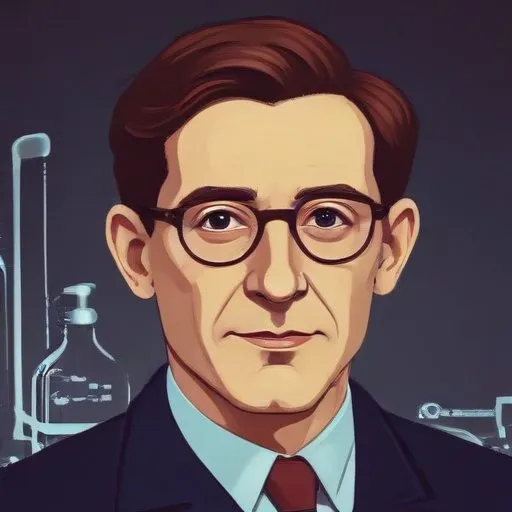
Developed groundbreaking catalysts that revolutionized the petroleum industry, enabling the mass production of high-octane gasoline and plastics.
Paul Hugh Emmett, an American chemist, left an indelible mark on the scientific community through his groundbreaking work in catalysis and his crucial contributions to the Manhattan Project during World War II. He is renowned for his pioneering research on the separation of isotopes of uranium and the development of corrosive uranium gas, cementing his position as a trailblazer in his field.
Emmett was born on September 22, 1900, in Portland, Oregon, to John Hugh Emmett and Lavina Hutchins. His early life was marked by an unconventional upbringing, with his family living in a rail car for a year while his mother worked as a cook for the rail company. This unique experience perhaps influenced his adaptability and resilience, traits that would serve him well in his future scientific pursuits.
Emmett's academic prowess became apparent in his high school days, where he excelled in language and mathematics. Notably, he was acquainted with Linus Pauling, a future two-time Nobel Prize winner, during this period. Emmett's fear of public speaking prompted him to enroll in the debate team, a decision that helped him develop essential communication skills.
His introduction to chemistry in high school sparked a deep interest in the subject, and he went on to pursue a degree in chemical engineering at Oregon State University in 1918. After completing his bachelor's degree in 1922, Emmett earned his Ph.D. in physical chemistry from the California Institute of Technology under the guidance of Arthur F. Benton.
Emmett's most significant contribution to science lies in his work on catalysis, a field that focuses on the acceleration of chemical reactions. His research on the BET theory, which explains the relationship between surface area and gas adsorption, has had a lasting impact on the understanding of catalytic processes.
During World War II, Emmett played a crucial role in the Manhattan Project, spearheading research on the separation of isotopes of uranium and the development of corrosive uranium gas. His work in this area was instrumental in the development of the atomic bomb.
Emmett's outstanding contributions to science earned him numerous accolades, including the Perkin Medal in 1944 and the Kendall Award in 1951. He was also elected as a member of the National Academy of Sciences in 1945.
Emmett's work on catalysis has far-reaching implications for various industries, including oil refining, petrochemicals, and environmental remediation. His research has enabled the development of more efficient and cost-effective processes, leading to significant advances in these fields.
Furthermore, his involvement in the Manhattan Project underscores the critical role scientists play in shaping global events. Emmett's work serves as a testament to the importance of scientific collaboration and its potential to drive technological progress.
Emmett served on the faculty of Johns Hopkins University for 23 years, a testament to his dedication to academia and research. He also held various positions in industry and government, including a stint as the director of the Fixed Nitrogen Research Laboratory.
Throughout his life, Emmett was driven by an insatiable curiosity and a passion for discovery. His legacy continues to inspire scientists and researchers, leaving an enduring mark on the scientific community.
Paul Hugh Emmett's remarkable journey, marked by groundbreaking research and significant contributions to the scientific community, serves as a testament to the power of human ingenuity and the importance of pursuing knowledge.
Born in 1881
Developed groundbreaking theories on surface chemistry and discovered neon lighting, revolutionizing industries like advertising and entertainment.
Born in 1903
A Nobel Prize-winning chemist and physicist who developed the Onsager reciprocal relations, a fundamental concept in thermodynamics, and made significant contributions to the understanding of electrolytes and ionic solutions.
Born in 1899
Developed quantum mechanics theories, including the concept of magnetism, and was awarded the Nobel Prize in Physics in 1977.
Born in 1901
Pioneering chemist and peace activist who won two unshared Nobel Prizes, one for chemistry and one for peace, for his groundbreaking work on the nature of the chemical bond and his tireless efforts to promote nuclear disarmament.
Born in 1875
Developed the concept of electron pairs and introduced the covalent bond, revolutionizing our understanding of chemical bonding.
Born in 1893
A pioneering scientist who discovered deuterium, a heavy isotope of hydrogen, and later contributed to the discovery of many other elements, revolutionizing our understanding of the universe.
Born in 1884
A Nobel Prize-winning physicist and chemist who pioneered work in molecular structure, quantum mechanics, and X-ray diffraction, making significant contributions to our understanding of molecular interactions.
Born in 1868
Developed a process to synthesize ammonia, revolutionizing agriculture and warfare, and was awarded the Nobel Prize in Chemistry in 1918.
