


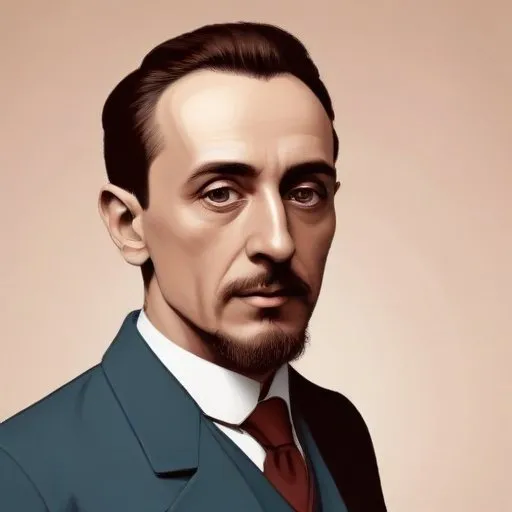
French physicist and academic who discovered piezoelectricity, a property of certain crystals that generate electric charge when subjected to mechanical stress. This breakthrough has numerous applications in modern technology, including sensors, actuators, and energy harvesting.
Paul-Jacques Curie, a French physicist, is renowned for his groundbreaking discovery of piezoelectricity, a phenomenon where certain materials generate an electric charge in response to mechanical stress. Alongside his brother Pierre Curie, Jacques CurieUnlocking the Secrets of Pyroelectricity
Born on October 29, 1855, in France, Jacques Curie was drawn to the world of science from an early age. He pursued his passion for physics and mineralogy, eventually becoming a laboratory assistant at the Faculty of Sciences in Paris. It was during this period that he began his research on pyroelectricity, laying the foundation for his future discoveries.
In 1880, Jacques Curie, along with his brother Pierre, made the pioneering discovery of piezoelectricity. While working under the guidance of Charles Friedel, they observed that certain crystals, such as quartz and Rochelle salt, generate an electric charge when subjected to mechanical stress. This breakthrough finding opened up new avenues for research in physics, materials science, and engineering.
The Curie brothers' collaboration on piezoelectricity is often overshadowed by Pierre's later success in radioactivity. However, historians agree that Jacques played a significant role in the discovery, bringing his expertise in pyroelectricity to the table. Despite this, Jacques' contributions were often downplayed in favor of his more charismatic brother.
Jacques Curie was appointed professor of mineralogy at the University of Montpellier in 1883, marking the beginning of his solo academic career. He continued to research and teach, eventually becoming chair of physics in 1903, a position he held until his retirement in 1925. His son, Maurice Curie, followed in his footsteps, becoming a physicist in his own right.
Jacques Curie's work on dielectric materials led to the Curie-von Schweidler law, which describes the response of these materials to direct current (DC) voltage. This fundamental principle has far-reaching implications for the development of modern electronics and materials science.
Jacques Curie spent several years teaching in Algeria (1887-1889) before returning to Montpellier, where he remained until his death on February 19, 1941. He was buried in the Saint-Lazare cemetery in Montpellier, leaving behind a legacy that continues to inspire scientists and engineers today.
Jacques Curie's discovery of piezoelectricity has had a profound impact on modern technology, influencing the development of sensors, actuators, and energy harvesting devices. His work has also paved the way for advances in fields such as aerospace, medicine, and renewable energy.
Paul-Jacques Curie's pioneering work on piezoelectricity has left an indelible mark on the scientific community. While his brother Pierre may have stolen the spotlight, Jacques' contributions to our understanding of pyroelectricity and dielectric materials are undeniable. His legacy serves as a testament to the power of collaboration, perseverance, and innovative thinking.
Born in 1859
A pioneer in radioactivity research, discovering elements like polonium and radium, and pioneering radioactive isolation techniques. Their groundbreaking work paved the way for advancements in medicine, energy, and materials science.
Born in 1867
A pioneering scientist who pioneered radioactivity research, discovering elements polonium and radium, and paving the way for breakthroughs in medicine and energy.
Born in 1852
Discovered radioactivity, a fundamental property of atoms, and pioneered research in the field, leading to breakthroughs in medicine, energy, and materials science.
Born in 1788
Discovered the phenomenon of radioactivity, pioneering the field of nuclear physics and earning a Nobel Prize in 1903.
Born in 1774
A French polymath who made significant contributions to the fields of physics, astronomy, and mathematics, particularly in the discovery of chromatic polarization and the Biot-Savart law.
Born in 1791
Developed the Biot-Savart law, a fundamental principle in electromagnetism, and made significant contributions to the field of psychology.
Born in 1775
A pioneer in the field of electromagnetism, he formulated fundamental laws that describe the relationship between electric currents and magnetic fields. His work laid the foundation for many modern technologies, including electric motors and generators.
