


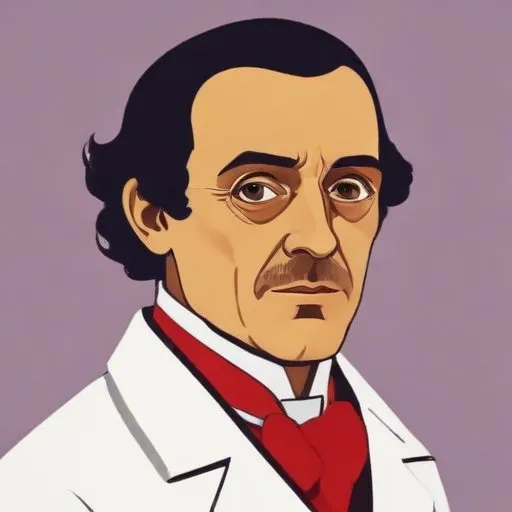
Discovered several elements, including gallium, and developed an improved method for obtaining pure samples of these elements. His work expanded the understanding of the periodic table.
Paulmile Lecoq de Boisbaudran was a renowned French chemist who made groundbreaking discoveries, including the identification of the chemical elements gallium, samarium, and dysprosium. Through his innovative methods for separating and purifying rare earth elements, he became a pioneer in the field of spectroscopy.
Born on April 18, 1838, into a noble Huguenot family in France, Paulmile was the son of Paul Lecoq de Boisbaudran and his wife Anne Louise. Despite the family's wealth and social standing, they faced persecution and financial losses following the revocation of the Edict of Nantes in 1685. This led to the confiscation and sale of their property, forcing the family to start anew.
Anne Louise, a well-educated woman, played a significant role in Paulmile's early education, teaching him history and foreign languages, including English. Encouraged by his family, Paulmile developed a passion for science, particularly chemistry, and pursued self-study through the syllabus of the École Polytechnique.
De Boisbaudran's self-taught background did not hinder his remarkable scientific achievements. He established a modest laboratory in his family's home, where he repeated experiments from books and developed his theories on spectroscopy. This led to his discovery of gallium in 1875, which he named after Gallia, the Latin name for France.
De Boisbaudran's outstanding contributions to chemistry did not go unnoticed. He was awarded the Copley Medal in 1879 by the Royal Society for his pioneering work on spectroscopy and the discovery of gallium.
De Boisbaudran's work had a profound impact on the field of chemistry, paving the way for future discoveries and advancements in spectroscopy. His methods for separating and purifying rare earth elements remain influential to this day, making him a prominent figure in the history of chemistry.
Today, de Boisbaudran's legacy extends beyond the scientific community. His story serves as an inspiration to anyone pursuing a passion, regardless of their background or circumstances.
Aside from his remarkable scientific achievements, de Boisbaudran was a devoted family man. He married and had four children, and his family played a significant role in supporting his scientific endeavors.
De Boisbaudran's determination and perseverance in the face of adversity serve as a testament to the power of human spirit and the importance of following one's passion.
Born in 1867
A pioneering scientist who pioneered radioactivity research, discovering elements polonium and radium, and paving the way for breakthroughs in medicine and energy.
Born in 1859
A pioneer in radioactivity research, discovering elements like polonium and radium, and pioneering radioactive isolation techniques. Their groundbreaking work paved the way for advancements in medicine, energy, and materials science.
Born in 1852
Discovered radioactivity, a fundamental property of atoms, and pioneered research in the field, leading to breakthroughs in medicine, energy, and materials science.
Born in 1743
Father of modern chemistry, discovered oxygen, and developed a systematic method of chemical nomenclature. He laid the foundation for modern chemistry and paved the way for future scientific discoveries.
83 Years Old
A British bassist who played with bands like The Levellers and Faithless, known for his energetic stage presence and distinctive bass lines.
Born in 1776
Formulated the molecular hypothesis, which states that equal volumes of gases at the same temperature and pressure contain an equal number of molecules. This concept is fundamental to understanding chemistry and physics.
Born in 1778
Pioneering chemist and physicist who discovered several elements, including potassium and sodium, and invented the Davy lamp, a safety lamp for miners. His groundbreaking work laid the foundation for modern chemistry and electrochemistry.
