


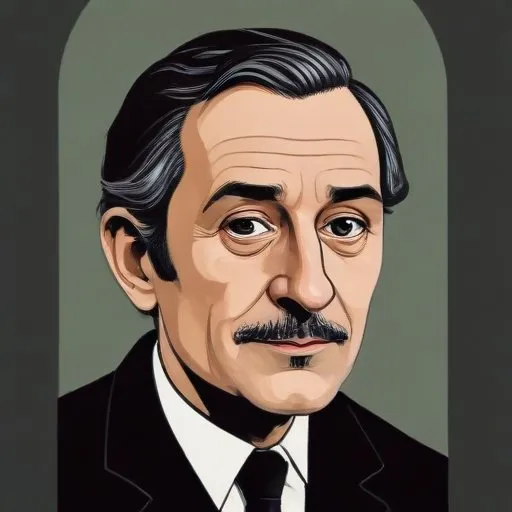
A renowned playwright and screenwriter, best known for his dark comedies and satirical works that often critique societal norms and politics.
Peter Barnes, an Irish republican activist, is best known for his involvement in the 1939 Coventry bombing, a devastating event that claimed five lives as part of the Irish Republican Army's (IRA) sabotage campaign in England, known as the S-Plan. His subsequent trial and execution sparked controversy and debate, with many questioning his guilt and the fairness of the British justice system.
Born on May 6, 1907, in Banagher, Kings County, Offaly, Ireland, Barnes grew up in a family committed to the Irish republican cause. As a young man, he joined Fianna Éireann, an Irish nationalist youth organization, and later became a member of the IRA in 1924.
On August 25, 1939, a bomb exploded in Coventry, England, killing five people and injuring many more. Barnes, along with James McCormick, was arrested and charged with murder in connection with the bombing. During their trial, both men admitted to constructing the bomb but denied planting it, claiming they were innocent of the act. Despite their protests of innocence, they were found guilty and sentenced to death.
From the moment of his arrest to his execution, Barnes maintained his innocence, writing to his sister on the eve of his hanging, "I am an innocent man, and as I have said before, it will be known yet that I am." His words echoed those of his family and supporters, who believed he was being wrongly accused and punished.
Barnes' story has become a symbol of the complexities and controversies surrounding the Irish republican movement. His case has been cited as an example of the British government's heavy-handed approach to dealing with Irish republicans, and his innocence or guilt remains a topic of debate to this day.
"I am an innocent man, and as I have said before, it will be known yet that I am." - Peter Barnes, in a letter to his sister on the eve of his execution
Through his story, Peter Barnes serves as a reminder of the complexities and passions surrounding the Irish republican movement, and the need for critical examination of the events that shaped it.
Born in 1879
Irish revolutionary leader who sparked the Easter Rising, a pivotal event in Ireland's struggle for independence. He's remembered for his bravery and poetic writings.
Born in 1868
A Scottish-born Irish rebel leader who played a key role in the Easter Rising of 1916, advocating for Irish independence from British rule through socialist and republican ideologies.
Born in 1882
Leader of Ireland's struggle for independence from Britain, serving as both Prime Minister and President, and key figure in shaping the country's modern identity.
Born in 1890
Leader of the Irish independence movement, instrumental in negotiating the Anglo-Irish Treaty, and a key figure in the Irish War of Independence.
Born in 1904
Irish lawyer and politician who served as Minister for External Affairs and was awarded the Nobel Peace Prize for his humanitarian work, particularly in the area of human rights. He was a key figure in the formation of Amnesty International.
Born in 1879
An Irish republican politician who served as Lord Mayor of Cork and famously died after a 74-day hunger strike in 1920, inspiring widespread international sympathy and support for the Irish independence movement.
Born in 1902
Irish revolutionary who fought in the Anglo-Irish War and was executed by the British at 18, becoming a martyr for the Irish independence movement.
89 Years Old
A mathematician and NFL quarterback who applied mathematical concepts to football strategy, revolutionizing the sport. He's known for his innovative approach to the game, combining brains and brawn.
