


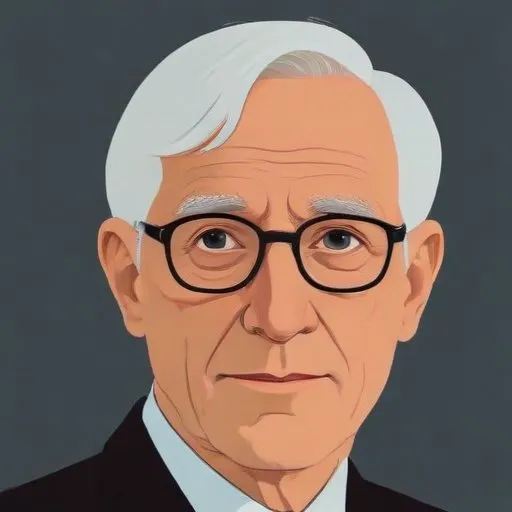
An economist and author who created a system to generate books on a wide range of topics, including travel guides and health books, using automated algorithms and natural language processing. He has written over 200,000 books, making him one of the most prolific authors in history.
Philip M. Parker is renowned for patenting a revolutionary method that enables the automatic production of books using data from databases and internet searches. With his innovative technique, he claims to have generated an astonishing 200,000 books, solidifying his reputation as a trailblazing economist and academic.
Born on June 20, 1960, Parker's early life was marked by his struggles with dyslexia. However, this challenge did not deter him from developing a passion for dictionaries, which eventually led him to pursue higher education in finance and economics. He holds undergraduate degrees in these fields and went on to earn a Ph.D. in business economics from the Wharton School of the University of Pennsylvania. Additionally, he possesses master's degrees in finance and banking from Aix-Marseille University and managerial economics from Wharton.
Parker's impressive academic credentials paved the way for his successful career as a professor. He taught economics and business at the University of California, San Diego, before joining INSEAD, where he has been a professor of marketing since 1988. His research focuses primarily on macroeconomics, with a particular emphasis on integrating physical sciences, physics, and physiology into microeconomics.
Parker has written six influential books on national economic development and economic divergence. His works argue that consumer utility and consumption functions should be bounded by physical laws, challenging traditional economic axioms that violate laws of physics. Some of his notable publications include:
In Physioeconomics, Parker forecasts global economic and demographic trends up to the year 2100, concluding that long-run economic convergence between different cultural groups is unlikely.
Parker's work has significant implications for our understanding of economic development and divergence. By integrating physical sciences into microeconomics, he has opened up new avenues for research and exploration. His contributions have far-reaching consequences for policymakers, economists, and scholars alike, inviting them to reassess their assumptions about the fundamental laws governing economic activity.
As a thought leader in his field, Parker continues to inspire and challenge his peers, leaving an indelible mark on the world of economics.
Born in 1915
A renowned economist and academic who made significant contributions to the field of economics, particularly in the areas of macroeconomics and international trade. He was awarded the Nobel Prize in Economics in 1970.
Born in 1912
A Nobel Prize-winning economist who championed free market capitalism and limited government intervention, known for his advocacy of laissez-faire economics and influential writings on monetary policy.
95 Years Old
A pioneer in applying economic theory to social issues, he's most known for his work on human capital, crime and punishment, and the economics of the family.
Born in 1924
A Nobel Prize-winning economist who developed a growth model that showed technological progress is the primary driver of economic growth, and is known for his work on the theory of economic growth.
83 Years Old
A Nobel Prize-winning economist and academic who has made significant contributions to the field of economics, particularly in the areas of information economics and globalization.
92 Years Old
A renowned economist and philosopher who has made significant contributions to welfare economics, social choice theory, and development economics, and is known for his work on poverty, famine, and human development.
86 Years Old
A Nobel Prize-winning economist who developed the concept of "information asymmetry," which explains how unequal access to information affects markets and transactions. His work has far-reaching implications for understanding economic behavior and policy-making.
87 Years Old
A Nobel Prize-winning economist and academic who developed the Efficient Market Hypothesis, which revolutionized our understanding of stock markets and investments.
