


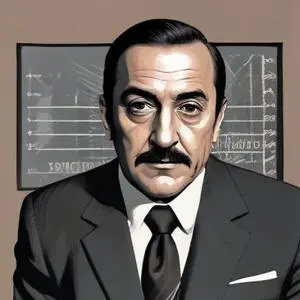
Conducted the Stanford prison experiment, a groundbreaking study on the psychology of imprisonment, and has written extensively on shyness and heroism.
Philip Zimbardo is a name synonymous with one of the most controversial and thought-provoking psychology experiments in history – the Stanford prison experiment. This groundbreaking study, conducted in 1971, delved into the darkest aspects of human behavior, revealing the shocking consequences of unchecked power and the effects of situational forces on human behavior.
Born on March 23, 1933, in New York City to Italian immigrant parents, Zimbardo grew up in the South Bronx, experiencing discrimination and prejudice firsthand. These early life experiences kindled a curiosity about human behavior, which would eventually become the driving force behind his groundbreaking research.
Zimbardo's academic journey began at Brooklyn College, where he earned a triple major in psychology, sociology, and anthropology in 1954. He then went on to pursue his M.S. (1955) and Ph.D. (1959) in psychology from Yale University, under the guidance of renowned psychologist Neal E. Miller. During his time at Yale, he married fellow graduate student Rose Abdelnour, with whom he had a son in 1962.
Zimbardo's teaching career spanned several prestigious institutions, including Yale, New York University, and Columbia University, before he joined the faculty at Stanford University in 1968. Over the next five decades, he would go on to teach and conduct research at Stanford, earning a reputation as a trailblazing psychologist.
In 1971, Zimbardo conducted the Stanford prison experiment, a study that would shatter conventions and spark intense debate in the scientific community. The experiment involved recruiting 24 male college students, randomly assigning them to play the roles of prisoners and guards in a simulated prison environment. The study was meant to last for two weeks, but it was terminated after just six days due to the alarming behavior exhibited by the participants.
The results of the study revealed the shocking extent to which situational forces can shape human behavior, with the "guards" enforcing sadistic and authoritarian rules, and the "prisoners" descending into submissiveness and despair. The experiment's findings challenged traditional notions of morality and raised fundamental questions about the nature of humanity.
While the Stanford prison experiment has been the subject of intense criticism and controversy, it has also inspired a new wave of research into the psychology of human behavior. Zimbardo's work has influenced numerous fields, including psychology, sociology, and philosophy, and has sparked a deeper understanding of the complex factors that shape human behavior.
Philip Zimbardo's work continues to inspire and provoke, challenging our understanding of human nature and the forces that shape our behavior. Love him or criticize him, Zimbardo's legacy is undeniable – a testament to the power of curiosity, inquiry, and the pursuit of knowledge.
93 Years Old
Conducted controversial obedience experiments, revealing the willingness of ordinary people to follow authority figures, even when instructed to perform harmful acts.
Born in 1916
A pioneer in artificial intelligence, decision-making, and problem-solving, he's renowned for his work on bounded rationality and the concept of satisficing.
92 Years Old
A Nobel Prize-winning economist and psychologist who pioneered the field of behavioral economics, revealing how cognitive biases and heuristics influence human decision-making.
89 Years Old
A pioneer in behavioral economics, he challenged traditional economic theories by showing how cognitive biases and heuristics influence human decision-making, revolutionizing our understanding of human behavior.
81 Years Old
A renowned expert in human memory and eyewitness testimony, known for challenging the reliability of memories and demonstrating how they can be altered or fabricated.
