


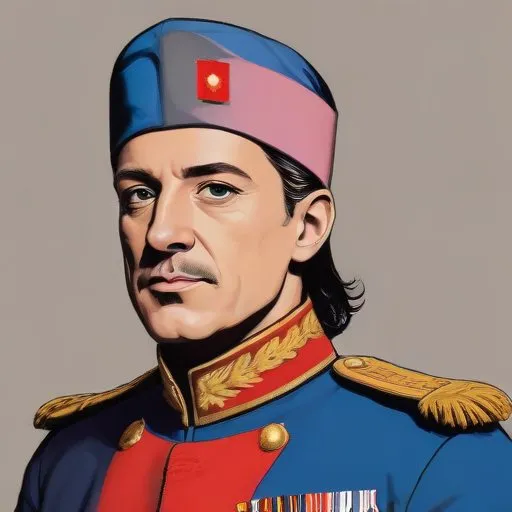
A French military leader who played a key role in the American Revolutionary War, helping the Continental Army secure crucial victories. He's also known for being a Marshal of France.
Philippe de Noailles, a renowned French aristocrat and military leader, is best known for his distinguished service as a Marshal of France and his prominent role in the French Revolution. Born on December 27, 1715, in Paris, France, de Noailles was a younger brother of Louis de Noailles and became one of the most respected military figures of his time.
De Noailles was the son of Françoise Charlotte d'Aubigné, niece of Madame de Maintenon, and was born into a life of nobility and privilege. He began his military career at a young age and quickly rose through the ranks, serving at the Battle of Minden and other campaigns. His exceptional military prowess earned him the respect and admiration of his peers, and he was made a Marshal of France in 1775, along with his brother.
De Noailles' military achievements and noble lineage secured him a position of great favor at the French court. His wife, Anne d'Arpajon, Comtesse de Noailles, held the esteemed position of First Lady of Honor to Queen Marie Antoinette, earning the nickname "Madame Etiquette" for her strict adherence to court protocol. De Noailles' own influence extended to the highest echelons of French society, and he was accorded the Spanish title of Prince de Poix in 1729, followed by the title of Duc de Mouchy with Grandeeship attached in 1747.
However, de Noailles' close ties to the royal family ultimately proved to be his downfall. During the French Revolution, he and his family were targeted by the radical revolutionaries, who viewed them as symbols of the aristocracy and the old regime. De Noailles, his wife, sister, daughter-in-law, and granddaughter were all guillotined on June 27, 1794, in the Reign of Terror. This tragic event marked the end of an era for the Noailles family and served as a stark reminder of the brutal consequences of the Revolution.
Throughout his life, de Noailles accumulated an impressive array of titles and honors, including the French title of Duc de Poix, which was granted to him in 1767. His son, Charles-Adrien, held the courtesy title of Prince de Poix from birth, and after his death, the title passed to de Noailles' successor, Philippe-Louis-Marc-Antoine. Two of de Noailles' surviving sons, Philippe-Louis-Marc-Antoine and Louis-Marie, went on to become members of the National Constituent Assembly.
De Noailles' remarkable life and legacy serve as a testament to the complexities and contradictions of the French Revolution, which saw the rise and fall of some of the most influential figures in French history.
Born in 1462
The king who ruled France from 1498 to 1515, known for his military campaigns in Italy and his role in the Italian Wars, which shaped the country's foreign policy.
Born in 1755
The last queen of France before the French Revolution, known for her extravagance and mismanagement of the French economy, which contributed to the downfall of the monarchy.
Born in 1767
A flamboyant and daring cavalry commander who played a key role in Napoleon's military conquests, earning the title of King of Naples.
Born in 1769
A skilled military strategist and one of Napoleon's most trusted generals, known for his bravery and tactical genius on the battlefield.
Born in 1758
A skilled military strategist and one of Napoleon's most trusted generals, known for his victories in the Peninsular War and his role in shaping modern warfare.
Born in 1769
A skilled and fearless military leader, known for his bravery and tactical genius on the battlefield, particularly during the Napoleonic Wars.
Born in 1770
A renowned military strategist and statesman who played a crucial role in Napoleon's conquests and later became a key figure in French politics, known for his exceptional organizational skills and bravery.
