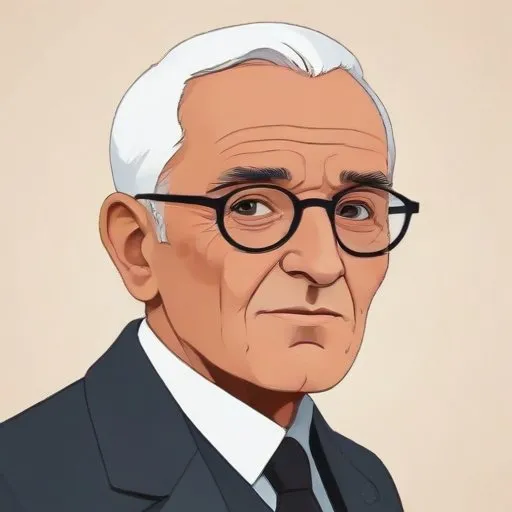
Pierre Jean George Cabanis

Pierre Jean George Cabanis

Pierre Jean George Cabanis was born on June 5th, 1757

Full Name: Pierre-Jean-George Cabanis
Born: 1757
Occupation: Physiologist and Philosopher
Death: 1808
Nationality: French
Notable Work: Rapports du physique et du moral de lhomme
Field of Study: Physiology and Philosophy
Influence: French Revolution

A French physiologist and philosopher who explored the connection between mind and body, and is known for his work on the relationship between the brain and nervous system. He also wrote about the importance of education and social reform.

Written by: Emma Thompson Emma Thompson

Pierre Jean George Cabanis: The French Philosopher and Physiologist

A Pioneer in the Field of Physiology and Philosophy

Pierre Jean George Cabanis was a French physiologist, philosopher, and politician, known for his groundbreaking work in the fields of physiology, philosophy, and psychology. He is credited with establishing the concept of the "relations between the physical and moral aspects of man," which laid the foundation for the field of psychophysiology.

Early Life and Education

Born on June 5, 1757, in Cosnac, France, Cabanis came from a family of modest means. His early education was marked by a strong interest in science and philosophy, which led him to pursue higher studies in medicine and philosophy at the University of Montpellier.

Philosophical Contributions and Beliefs

Cabanis' philosophical contributions were deeply rooted in the Enlightenment ideals of reason, empiricism, and humanism. He believed that the human being is a unity of body and mind, and that the study of physiology and psychology must be undertaken together to understand human nature. His philosophical works, such as Rapports du physique et du moral de l'homme, explored the relationships between the physical and moral aspects of human beings.

Major Works and Career Highlights

Cabanis' most notable work, Rapports du physique et du moral de l'homme, published in 1802, is considered a seminal work in the field of psychophysiology. In this work, he proposed that the brain is a gland that secretes thought, and that the nervous system is the seat of the soul.

Some of his notable career highlights include:

Influence on Modern Society

Cabanis' work had a significant impact on modern psychology, physiology, and philosophy. His ideas on the interdependence of body and mind influenced the development of fields such as neuroscience, psychosomatic medicine, and existential philosophy.

His ideas on the importance of education and social reform also had a lasting impact on French society, influencing the development of public education and social welfare policies.

Personal Life and Relationships

Cabanis was known for his warm and engaging personality, and his relationships with prominent figures of the time, including Napoleon Bonaparte, with whom he had a close friendship.

Controversies and Public Perception

Cabanis' views on the materiality of the soul and the role of the brain in thinking were controversial during his time, leading to criticisms from both religious and scientific circles.

Legacy and Historical Context

Cabanis' work and ideas have had a lasting impact on the development of modern science, philosophy, and psychology. His legacy can be seen in the works of philosophers such as Auguste Comte and Henri Bergson, and scientists such as Claude Bernard and Ivan Pavlov.

As we look back on Cabanis' life and work, we are reminded of the power of interdisciplinary approaches to understanding human nature and the importance of considering the interdependence of body and mind.

His work serves as a testament to the enduring legacy of the Enlightenment ideals of reason, empiricism, and humanism, and continues to inspire new generations of scholars and thinkers.

As we reflect on Cabanis' life and contributions, we are left with the following quote, which encapsulates the essence of his philosophy:

"The human being is a unity of body and mind, and it is only by studying both together that we can hope to understand human nature."
Timeline
1757
Born in Cosnac, France
Pierre Jean George Cabanis was born in Cosnac, France, into a noble family.
1789
Published Observations on the Hospitals of Paris
He published Observations on the Hospitals of Paris, which critiqued the French healthcare system.
1791
Became a Member of the National Assembly
Cabanis became a member of the National Assembly, where he advocated for social and medical reform.
1804
Founded the Parisian Society of Medicine
He founded the Parisian Society of Medicine, which aimed to improve medical practice and education.
1808
Died in Ruelle, France
Pierre Jean George Cabanis died in Ruelle, France, at the age of 51, leaving behind a legacy as a pioneering physiologist and social reformer.
Pierre Jean George Cabanis

Pierre Jean George Cabanis Quiz

Pierre Jean George Cabanis is known for his work on the relationship between the

Score: 0/5
FAQ
What was Pierre Jean George Cabaniss contribution to the field of physiology?
Cabanis made significant contributions to the field of physiology, particularly in the areas of the nervous system and the study of brain function.
What philosophical ideas did Pierre Jean George Cabanis espouse?
Cabanis was a materialist who believed in the concept of sensationalism, which held that all knowledge comes from sensory experience and that the mind is a product of the brain.
How did Pierre Jean George Cabaniss ideas influence French philosophy?
Cabaniss ideas had a significant influence on French philosophy, particularly in the areas of materialism and empiricism, and shaped the development of French thought in the late 18th and early 19th centuries.
What was Pierre Jean George Cabaniss relationship like with other French thinkers?
Cabanis was a prominent figure in French intellectual circles and had close relationships with other prominent thinkers, including Denis Diderot and Paul Henri Thiry dHolbach.
What is Pierre Jean George Cabaniss legacy in the history of science?
Cabaniss legacy in the history of science is that of a pioneering physiologist who helped lay the foundations for modern neuroscience and contributed to the development of materialist thought in France.

Related People:

Georges Cuvier

Born in 1769

Founded the field of comparative anatomy, establishing extinction as a fact and creating a framework for understanding the natural world through fossil records.

Jean-Baptiste Lamarck

Born in 1744

A French soldier, biologist, and academic who developed a theory of inheritance of acquired characteristics, proposing that organisms adapt to their environment and pass on those traits to their offspring.

Born in 1772

A pioneering figure in the field of comparative anatomy, he is renowned for his groundbreaking work on the concept of unity of composition, which posits that all animals share a common body plan. His research laid the foundation for modern evolutionary biology.

Henri Dutrochet

Born in 1776

A French physician, botanist, and physiologist who discovered the process of osmosis and made significant contributions to the field of plant physiology. His work laid the foundation for modern understanding of plant biology.

André Marie Constant Duméril

Born in 1774

A French zoologist and academic who made significant contributions to the field of herpetology, particularly in the study of reptiles and amphibians. He is known for his comprehensive works on the classification and description of species.