


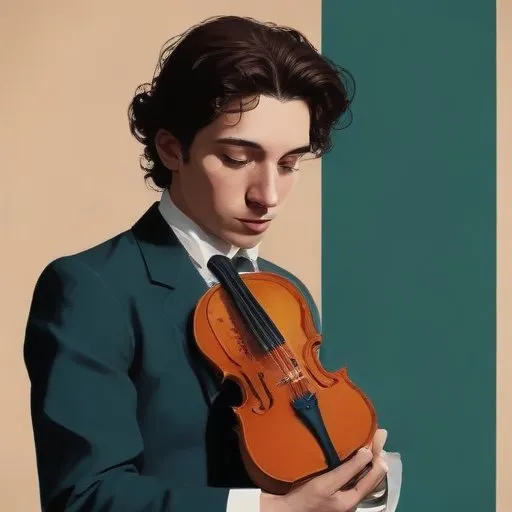
A virtuosic violinist and prolific composer, known for his innovative and technically demanding concertos that showcased his mastery of the instrument. His works had a significant impact on the development of classical music.
When it comes to the world of Baroque music, few names resonate as strongly as Pietro Antonio Locatelli, an Italian composer and violinist who left an indelible mark on the musical landscape of the 18th century. Known for his innovative and technically demanding compositions, Locatelli was a true virtuoso of his time, earning him the admiration of royalty and nobility alike.
Born on September 3, 1695, in Bergamo, Italy, Locatelli's early life remains somewhat of a mystery. However, it is known that he began his musical training at a young age, studying under notable violinists Ludovico Ferronati and Carlo Antonio Marino. His compositional skills were likely honed under the guidance of Francesco Ballarotti, the maestro di cappella of the church of Santa Maria Maggiore in Bergamo.
In 1711, Locatelli made the bold decision to travel to Rome, seeking greater recognition and opportunities. It was during this period that he studied under esteemed composers Antonio Montanari and Giuseppe Valentini, and possibly even the legendary Arcangelo Corelli. Locatelli's talent and dedication soon earned him membership in the prestigious compita accademia di vari instrumenti, the household musicians of Prince Michelangelo I Caetani.
In 1721, Locatelli's debut as a composer was marked by the publication of his XII Concerti grossi, Op. 1, dedicated to Camillo Cybo. This groundbreaking work showcased his innovative approach to the concerto grosso form, earning him widespread recognition and acclaim.
Between 1723 and 1728, Locatelli embarked on a series of travels throughout Italy and Germany, performing in prominent cities such as Mantua, Venice, Munich, Dresden, Berlin, Frankfurt, and Kassel. During this period, he likely composed many of his renowned violin concertos and capricci, solidifying his reputation as a master of the Baroque style.
Locatelli's impact on the world of classical music cannot be overstated. His compositions, characterized by technical virtuosity and harmonic innovation, have influenced generations of musicians and composers. Today, his music remains a staple of classical music repertoire, with many of his works still widely performed and admired.
Locatelli's music has transcended time, continuing to inspire and influence contemporary musicians and composers. His innovative approach to the concerto grosso form has had a lasting impact on the development of classical music, making him an essential figure in the Baroque era.
Though few direct quotes from Locatelli exist, his music speaks volumes about his artistic philosophy. As a testament to his dedication to his craft, he once wrote to his father, "I am a confirmed member of the compita accademia di vari instrumenti."
Locatelli's life and work are a testament to the rich cultural heritage of the Baroque era. His contributions to the development of classical music have secured his place among the pantheon of great composers, ensuring his legacy will continue to inspire and delight audiences for generations to come.
As a celebration of his life and work, Pietro Antonio Locatelli's music remains an integral part of our cultural heritage, a timeless tribute to the power of creativity and innovation.
Born in 1678
A virtuosic violinist and prolific composer, he crafted over 400 concertos, including "The Four Seasons," which remains a beloved and iconic masterpiece of classical music.
Born in 1685
A master of Baroque music, he composed over 1,000 works, including orchestral suites, cantatas, and passions, that still inspire and influence musicians today. His innovative use of counterpoint and harmony raised the bar for classical music.
Born in 1685
A renowned Baroque composer and organist, famous for creating majestic orchestral suites, operas, and oratorios, including the iconic "Messiah" masterpiece.
Born in 1653
A virtuosic violinist and composer who revolutionized the concerto grosso form, creating a new era of classical music. His influential works elevated the violin to a solo instrument, shaping the course of Western classical music.
Born in 1692
A virtuosic violinist and composer who wrote over 150 concertos and sonatas, known for his technically demanding and expressive works that showcased his mastery of the instrument.
Born in 1782
A virtuosic violinist and composer who revolutionized the instrument's technical possibilities, leaving an indelible mark on classical music.
Born in 1756
A child prodigy and master of classical music, he composed over 600 works, including symphonies, operas, and chamber music, that continue to inspire and influence musicians today.
Born in 1770
A musical genius who expanded the possibilities of classical music, creating iconic symphonies and piano sonatas that continue to inspire and influence generations of artists.
