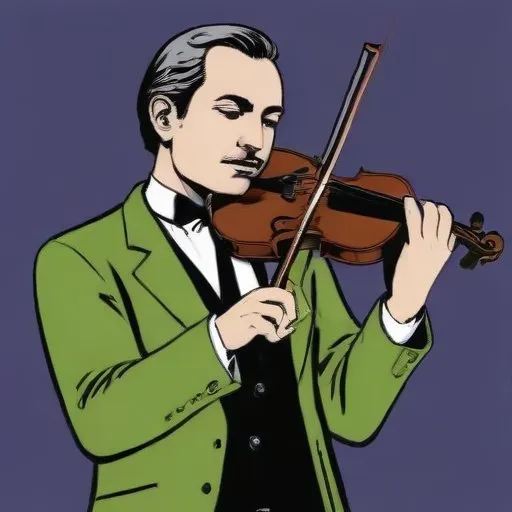
Pietro Nardini: The Maestro of Melodious Strings
A Virtuoso of Transition: Bridging Baroque and Classical Eras
Pietro Nardini, a renowned Italian composer and violinist, was a master of his craft, effortlessly navigating the transition between the Baroque and Classical eras. Known for his soulful, melodious compositions and technical excellence, Nardini left an indelible mark on the world of music.
A Life of Musical Pursuits
Born in Livorno, Italy on April 12, 1722, Nardini began his musical journey at the tender age of 12, studying under the watchful eye of the celebrated composer and violinist
Giuseppe Tartini in Padua. This early training laid the foundation for his subsequent success, as he honed his skills and developed his unique style.
A Peripatetic Career: Courtly Encounters and Royal Patrons
Nardini's career was marked by a series of prestigious appointments and performances at various European courts. In 1740, he moved to Lucca, and later, in 1762, he joined the court of Charles Eugene, Duke of Württemberg in Stuttgart, succeeding
Niccolò Jommelli as conductor. This period saw him perform at the majestic Ludwigsburg Palace, where he impressed audiences with his virtuosity. His travels took him to the courts of Charles I, Duke of Brunswick-Wolfenbüttel and Prince
Francis Xavier of Saxony in 1765, and later, to Italy, where he assisted his ailing mentor, Tartini.
Encounters with Musical Giants
Nardini's life was filled with encounters with some of the most influential figures of his time. He befriended
Leopold Mozart, father of the legendary
Wolfgang Amadeus Mozart, and witnessed the young prodigy's first visit to Italy in 1770-71. He also met the Bohemian composer Václav Pichl, Kapellmeister to Ferdinand Karl, Archduke of Austria-Este. In 1778, he was invited by
Catherine the Great to perform at her court.
A Compositional Legacy: Sentimental Melodies and Technical Mastery
Though Nardini was not a prolific composer, his works are distinguished by their emotional depth and technical sophistication. His Sonata in D major and Concerto in E minor are considered some of the most beautiful and technically challenging pieces of their time. As a teacher, he mentored several notable students, including Bartolomeo Campagnoli, Filippo Manfredi, Thomas Linley the younger, Giovanni Francesco Giuliani, and perhaps Giuseppe Cambini and Gaetano Brunetti.
In the Spotlight: A Concerto in Florence
In 1785, Nardini performed a solo at a concert hosted by the English writer Hester Lynch Piozzi and her husband, Gabriele Piozzi, in Florence. This event was immortalized in Hester's Observations and Reflections Made in the Course of a Journey Through France, Italy, and Germany, showcasing Nardini's enduring popularity as a performer.
A Lasting Legacy: A Testament to Melodic Beauty
Pietro Nardini's life was a testament to his unwavering dedication to his craft. His music continues to inspire generations of musicians and music lovers alike, serving as a reminder of the power of beauty and elegance in art. As a composer, performer, and teacher, Nardini left behind a rich legacy that transcends time and borders, a legacy that will forever be woven into the fabric of classical music.
FAQ
What was Pietro Nardinis occupation?
Pietro Nardini was an Italian violinist and composer, known for his virtuosic performances and lyrical compositions. He was a prominent figure in the development of classical music in the 18th century.
What was Pietro Nardinis most famous composition?
Pietro Nardinis most famous composition is his Concerto for Violin and Orchestra in E minor, a work that showcases his mastery of melody and technique.
Did Pietro Nardini perform with any notable musicians?
Yes, Pietro Nardini performed with several notable musicians, including the composer and conductor Christoph Willibald Gluck. He was also a member of the orchestra at the Teatro alla Scala in Milan.
What was Pietro Nardinis contribution to the development of classical music?
Pietro Nardini made significant contributions to the development of classical music, particularly in the areas of violin technique and orchestral music. His compositions and performances helped to establish the violin as a major instrument in classical music.
Is Pietro Nardini a notable figure in Italian music?
Yes, Pietro Nardini is a notable figure in Italian music, recognized for his virtuosic performances, lyrical compositions, and contributions to the development of classical music. He is remembered as one of the leading musicians of his era.