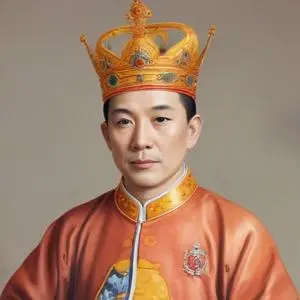
The Last Emperor of China: Puyi's Turbulent Reign
A Life of Imperial Intrigue and Conquest
Puyi, the eleventh and final monarch of the Qing dynasty, is known for his peculiar reign as the last emperor of China. At the tender age of two, he ascended to the throne in 1908, only to be forced to abdicate four years later as a result of the Xinhai Revolution.
Early Life and First Reign
Born on February 7, 1906, Puyi was destined for greatness. His era name, Xuantong, signified the "proclamation of unity," a fitting title for an emperor who would spend his life navigating the complexities of China's tumultuous early 20th century. During his first reign, Puyi's youth and inexperience led to a power vacuum, allowing advisors and regents to wield significant influence over the imperial court.
Restoration and Exile
In 1917, loyalist general Zhang Xun briefly restored Puyi to the Qing throne, but this fleeting reinstatement lasted only from July 1 to July 12. Following his second abdication, Puyi sought refuge in Tianjin, where he began to forge alliances with warlords and Japanese forces vying for control over the fractured Republic of China.
The Puppet Emperor of Manchukuo
In 1932, the Japanese invasion of Manchuria led to the establishment of the puppet state of Manchukuo, with Puyi as its chief executive. The following year, he was declared emperor, marking his third stint on the throne. Under the era name Kangde, Puyi's reign in Manchukuo was marked by his subservience to Japanese interests, signing edicts and decrees at their behest.
Personal Life and Turmoil
Puyi's personal life was rife with turmoil. His arranged marriage to Wanrong in 1922 was marked by distance and opium addiction, which would eventually consume his wife. He took numerous concubines and male lovers, often ordering his servants beaten. The once-majestic emperor's life was now a shadow of its former glory.
Capture and Trial
With Japan's surrender in 1945, Puyi fled the capital, only to be captured by the Soviets and later extradited to the People's Republic of China in 1950. He stood trial at the Tokyo War Crimes Tribunal, a poignant end to a life defined by imperial grandeur and political manipulation.
Legacy of the Last Emperor
Puyi's life serves as a microcosm of China's tumultuous 20th century, a tale of imperial decline, foreign occupation, and personal struggle. As the last emperor of China, Puyi's legacy is complex, marked by both the majesty of his imperial heritage and the tragedy of his tumultuous reign.
Fun Facts and Trivia
- Puyi holds the record for the most times ascending and abdicating the throne.
- His reign in Manchukuo was marked by his love of Western music, particularly Debussy and Chopin.
- Puyi was known for his exquisite calligraphy and painting skills.
FAQ
What was Puyis role in Chinese history?
Puyi was the last emperor of China, ruling from 1908 to 1912 and again from 1934 to 1945. He was a key figure in Chinese history, playing a significant role in the countrys transition from imperial rule to republicanism.
What was Puyis experience during the Chinese Revolution?
Puyi was forced to abdicate the throne in 1912 during the Chinese Revolution, marking the end of imperial rule in China.
What was Puyis role in the Second Sino-Japanese War?
Puyi was installed as the puppet emperor of Manchukuo by the Japanese during the Second Sino-Japanese War, leading to widespread criticism and resistance from the Chinese people.
What awards did Puyi receive for his work?
Puyi received numerous awards and honors during his lifetime, including the Order of the Paulownia Flowers from the Japanese government.
What is Puyis legacy in Chinese history?
Puyis work has had a lasting impact on Chinese history, particularly in the areas of imperial rule and the transition to republicanism. He is remembered as a complex and controversial figure, representing both the decline of the imperial system and the rise of modern China.