


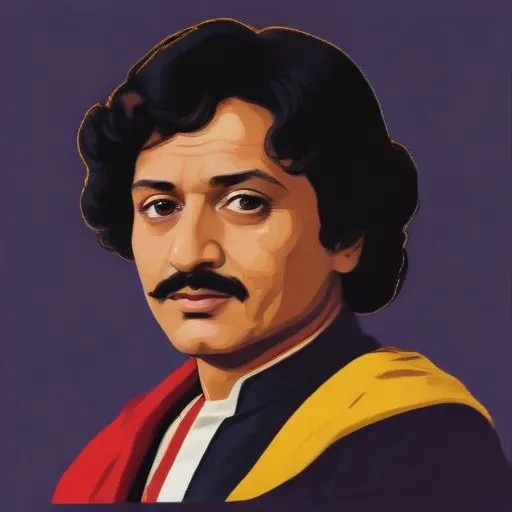
A pioneer of Indian social and religious reform, he fought against superstition and advocated for women's rights, education, and freedom of the press.
Ram Mohan Roy, a pioneering social reformer, philosopher, and educationist, is revered as the father of Indian Renaissance. He is known for his tireless efforts to modernize Indian society, abolish social evils, and promote education and women's rights.
Born on May 22, 1772, in Radhanagar, Bengal Presidency, Ram Mohan Roy was the son of Ramkanta Roy, a zamindar. He received his early education in Persian, Arabic, and Sanskrit, and later studied English and other European languages. This exposure to various languages and cultures laid the foundation for his broad-minded and progressive outlook.
Ram Mohan Roy was a strong advocate of monotheism and believed in the unity of God. He was influenced by the teachings of Islam, Christianity, and Hinduism, and sought to reconcile these faiths. He founded the Brahmo Samaj, a socio-religious organization that aimed to reform Hinduism and promote social and moral improvement.
His philosophical contributions include the concept of "Vedanta," which emphasizes the oneness of existence and the infinitude of the human soul. He also believed in the importance of reason, individual freedom, and social justice.
Ram Mohan Roy is renowned for his crusade against social evils such as sati (the practice of burning widows on their husbands' funeral pyres) and child marriage. He championed women's rights, education, and social reform, and played a key role in the abolition of sati in 1829.
He was a prolific writer and published several works, including the "Brahminal Magazine" and "The Gospel of John." He also founded the Anglo-Hindu School and the Vedanta College, which aimed to promote modern education and Indian cultural heritage.
Ram Mohan Roy's contributions have had a profound impact on modern Indian society. He inspired a generation of social reformers, including Swami Vivekananda and Mahatma Gandhi. His advocacy for women's rights and education paved the way for future generations of Indian women to pursue their dreams.
Ram Mohan Roy traveled extensively throughout his life, visiting countries such as Britain, France, and the United States. He was impressed by Western ideas and incorporated them into his reform efforts.
In 1833, he traveled to Britain as an ambassador of the Mughal Empire to negotiate the renewal of the East India Company's charter. During his stay, he was awarded an honorary doctorate from the University of Glasgow and was elected a Fellow of the Royal Asiatic Society.
Ram Mohan Roy's legacy extends beyond his reform movements and philosophical contributions. He is remembered as a visionary who inspired generations of Indians to strive for social justice, education, and women's empowerment.
Today, his birthday, May 22, is celebrated as National Education Day in India, a testament to his enduring impact on Indian society.
As we reflect on Ram Mohan Roy's life and legacy, we are reminded of the power of dedication, perseverance, and vision. His contributions continue to inspire us to work towards a more just and equitable society.
Born in 1863
A key figure in introducing Indian philosophies to the Western world, he's known for his inspiring lectures and writings on spirituality, self-realization, and the unity of all religions.
Born in 1869
Indian freedom fighter, activist, and philosopher who led India to independence from British rule through non-violent civil disobedience, inspiring civil rights movements worldwide.
Born in 1872
An Indian spiritual leader who developed a philosophy of integral yoga, aiming to unite spiritual growth with worldly life, and wrote extensively on spirituality, philosophy, and poetry.
Born in 1861
A Bengali polymath who wrote extensively on love, nature, and humanity, creating a unique blend of Indian and Western literary styles, and was the first non-European to win the Nobel Prize in Literature.
Born in 1876
A renowned Bengali novelist celebrated for his poignant and thought-provoking works that explored the complexities of Indian society, particularly the lives of women and the rural poor.
Born in 1838
A pioneering Bengali writer and poet who played a significant role in shaping Indian literature, known for his iconic novel "Anandamath" that inspired India's freedom movement.
Born in 1820
A 19th-century polymath who championed social reforms, particularly women's education and widow remarriage, through his writings and art. He's also credited with introducing the concept of prose in Bengali literature.
