


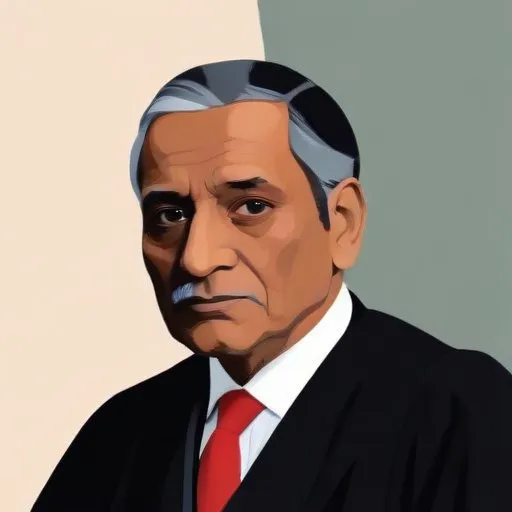
The 21st Chief Justice of India, a prominent figure in the country's judiciary, known for his significant contributions to Indian law and justice. He played a crucial role in shaping the country's legal landscape.
Ranganath Misra, the 21st Chief Justice of India, is renowned for his exemplary service to the nation, serving from 25 September 1990 to 24 November 1991. During his tenure, he played a pivotal role in shaping the country's judicial system, leaving an indelible mark on the Indian legal landscape.
Born on 25 November 1926 in Banapur, Odisha, Misra hails from an esteemed Odia Brahmin family. His father, Godavaris Mishra, was a prominent Congress politician and education minister of Orissa state in 1941, instrumental in the founding of Utkal University. Misra's family was steeped in politics, with his brothers, Lokanath and Raghunath, also making significant contributions to the Indian political sphere.
During his tenure as Chief Justice, Misra played a crucial role in shaping the country's judicial system. Some of his notable contributions include:
After his retirement from the Supreme Court, Misra continued to serve the nation in various capacities:
Ranganath Misra's contributions to the Indian legal system and human rights landscape are immeasurable. His commitment to justice, equality, and human dignity has left an indelible mark on the nation. As a trailblazing Chief Justice, he paved the way for future generations of legal luminaries, ensuring that his legacy continues to inspire and guide the Indian legal fraternity.
Born in 1884
India's first president, a key figure in the country's struggle for independence, who played a crucial role in shaping the nation's early years. He's revered for his leadership and commitment to democracy.
Born in 1891
Indian Minister of Law and Justice who fought for the rights of the marginalized and drafted the Indian Constitution, playing a key role in shaping modern India's democracy.
Born in 1889
India's first Prime Minister, a key figure in the country's struggle for independence from British rule, and a champion of democracy and secularism. He played a crucial role in shaping modern India's government and economy.
Born in 1917
The first female Prime Minister of India, serving from 1966 to 1977 and again from 1980 until her assassination in 1984, known for her strong leadership and economic reforms.
Born in 1896
Fourth Prime Minister of India, known for his efforts to decentralize power and promote economic development, and for being the first Indian Prime Minister to resign from office.
Born in 1902
The 5th Prime Minister of India, a champion of rural development and social justice, who implemented land reforms and empowered farmers. He played a crucial role in shaping India's agricultural sector and economy.
Born in 1924
A renowned Indian poet and politician who served as the country's 10th Prime Minister, known for his efforts to strengthen India's economy and improve relations with neighboring countries.
Born in 1904
The second Prime Minister of India, leading the country through a tumultuous period, including a war with Pakistan, and known for his simplicity, honesty, and dedication to the nation. He is also credited with promoting the Green Revolution, which transformed India's agricultural sector.
