


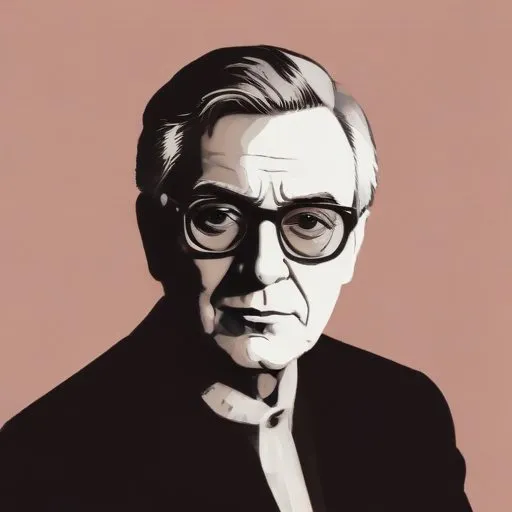
A French poet and author who experimented with language and form, creating innovative and playful works that blended poetry and prose. He's most known for his novel "Zazie in the Metro", a classic of 20th-century French literature.
Raymond Queneau is renowned for his witty and cynical humor, which permeates his extensive literary works, including novels, poetry, and critiques. As a cofounder and president of Oulipo (Ouvroir de littérature potentielle), Queneau played a significant role in shaping the literary landscape of 20th-century France.
Born on February 21, 1903, in Le Havre, Seine-Inférieure, Queneau was the only child of Auguste Queneau and Joséphine Mignot. He pursued his studies in Le Havre before moving to Paris in 1920, where he earned his first baccalaureate in philosophy from the University of Paris in 1925.
Queneau's military service in Algeria and Morocco during 1925-1926 significantly influenced his writing style. Upon his return to Paris, he took on various odd jobs, including working as a bank teller, tutor, and translator. He also wrote a column entitled "Connaissez-vous Paris" for the daily Intransigeant.
In 1928, Queneau married Janine Kahn, sister-in-law of André Breton, the leader of the surrealist movement. The couple had a son, Jean-Marie, in 1934, who went on to become a painter.
In 1960, Queneau cofounded Oulipo, a collective of writers and mathematicians dedicated to exploring the potential of language. As president, Queneau played a crucial role in shaping the group's literary endeavors, which sought to push the boundaries of language and narrative.
Queneau's work has had a profound impact on modern literature, inspiring generations of writers, including Georges Perec, Italo Calvino, and Jacques Roubaud. His unique blend of humor, wit, and critique has influenced the development of postmodern literature.
Queneau received numerous awards and honors for his contributions to literature, including the Prix des Critiques in 1955 and the Grand Prix National des Lettres in 1965.
Queneau's work remains a testament to his innovative spirit and commitment to literary experimentation. As a key figure in 20th-century French literature, Queneau's influence continues to be felt, inspiring new generations of writers and thinkers.
Raymond Queneau passed away on October 25, 1976, leaving behind a rich literary legacy that continues to captivate readers and writers alike.
Born in 1896
French poet and author who founded Surrealism, a cultural movement that explored the subconscious and the world of dreams. He wrote novels, poems, and essays that continue to influence art and literature today.
Born in 1886
A pioneer of Dadaism and Surrealism, this artist created abstract sculptures and paintings that explored the relationship between chance and creativity. Their work continues to inspire artists and designers today.
Born in 1897
A French philosopher, novelist, and poet who explored the relationships between eroticism, literature, and philosophy, and is known for his concept of "expenditure" and the idea that humans have an innate desire to waste and excess.
Born in 1899
A Belgian-French poet and painter who explored the subconscious through automatic writing and vibrant, abstract art, blending words and images to evoke emotions and inner experiences.
Born in 1900
A surrealist painter who created dreamlike, fantastical landscapes with melting objects and eerie atmospheres, blurring the line between reality and fantasy.
Born in 1900
A French poet and screenwriter who wrote lyrics for iconic songs and scripts for classic films, blending poetry and cinema to evoke powerful emotions.
