


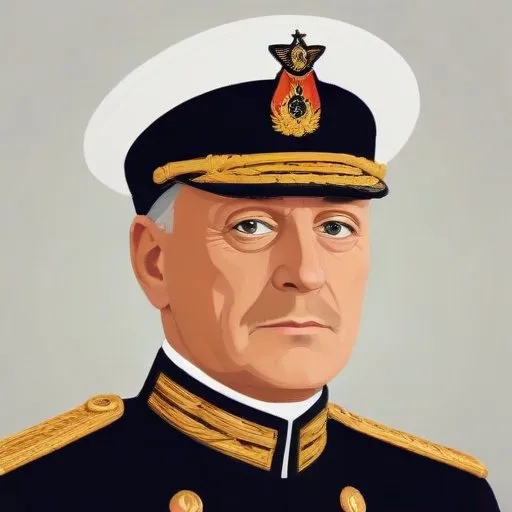
German admiral who led the Imperial German Navy's High Seas Fleet during World War I, particularly in the Battle of Jutland, and later advocated for unrestricted submarine warfare. He played a significant role in shaping Germany's naval strategy during the war.
Reinhard Scheer, a name synonymous with naval excellence, is renowned for his distinguished service as an Admiral in the Imperial German Navy during World War I. As the commander of the High Seas Fleet, he led the German naval forces at the epic Battle of Jutland, one of the largest naval battles in history.
Born on September 30, 1863, in Obernkirchen, Lower Saxony, Scheer hailed from a middle-class background. Despite the initial hurdles, he entered the navy on April 22, 1879, as a cadet, marking the beginning of his illustrious career.
Scheer progressed through the ranks, commanding cruisers and battleships, as well as holding senior staff positions on land. His dedication and impressive skills earned him a rapid rise through the ranks, eventually taking command of the II Battle Squadron of the High Seas Fleet at the outbreak of World War I.
Scheer's most notable achievement came when he led the German fleet at the Battle of Jutland on May 31, 1916. This pivotal battle remains one of the largest naval engagements in history, involving over 250 ships and 100,000 sailors. Scheer's strategic decisions and leadership during the battle earned him recognition as a skilled naval commander.
Following the Battle of Jutland, Scheer joined those calling for unrestricted submarine warfare against the Allies. He believed this tactic would weaken the enemy's supply lines and ultimately lead to a German victory. The Kaiser eventually permitted this strategy, which had far-reaching consequences for the war's outcome.
In August 1918, Scheer was promoted to Chief of Naval Staff, with Admiral Franz von Hipper replacing him as commander of the fleet. Together, they planned a final battle against the British Grand Fleet, but war-weary sailors mutinied, and the operation was abandoned.
Scheer retired after the end of the war and wrote his memoirs in 1919, which were later translated and published in English in 1920. He went on to write his autobiography in 1925. Scheer passed away on November 26, 1928, and was buried in the municipal cemetery at Weimar.
Scheer's strict disciplinary nature earned him the nickname "the man with the iron mask." His reputation as a stern leader and skilled commander was cemented in naval history, influencing generations to come.
The renascent Kriegsmarine honored Scheer by naming the heavy cruiser Admiral Scheer, built in the 1930s, after him. This tribute serves as a testament to his enduring legacy in the world of naval warfare.
Born in 1876
A German naval leader who played a key role in the Kriegsmarine during World War II, overseeing the German U-boat fleet and naval operations. He was a close advisor to Adolf Hitler and implemented the German naval strategy during the war.
Born in 1891
A German naval commander who led the U-boat fleet during World War II and briefly served as President of Germany after Hitler's death, known for his role in the war and its aftermath.
Born in 1847
A German field marshal and politician who served as the 2nd President of Germany during the Weimar Republic, playing a crucial role in the rise of the Nazi Party. He's infamous for appointing Adolf Hitler as Chancellor of Germany in 1933.
Born in 1865
A German general and politician who played a crucial role in World War I, masterminding the 1918 Spring Offensive and later promoting Nazi ideology.
Born in 1851
A French field marshal who played a crucial role in World War I, leading the Allied forces to victory and earning the title "The Tiger" for his tenacity and strategic genius. He's also known for his post-war efforts to maintain peace and stability in Europe.
