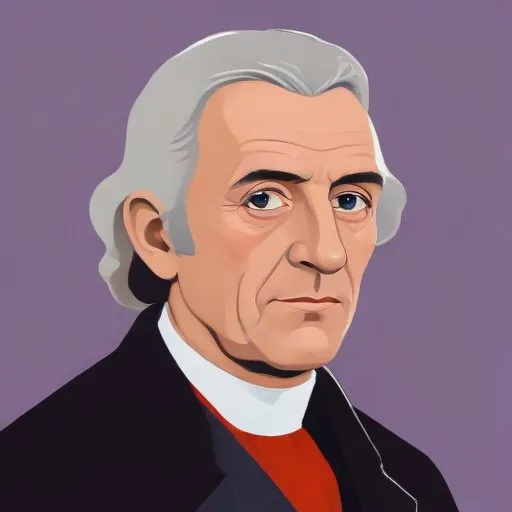
Richard Cumberland: The Pioneer of Utilitarianism and Eminent Bishop
A Champion of Moral Philosophy
Richard Cumberland is renowned for his groundbreaking work,
De Legibus Naturae, which propounded the principles of utilitarianism, challenging the egoistic ethics of
Thomas Hobbes. As a philosopher and Bishop of Peterborough from 1691, Cumberland's contributions to moral philosophy have had a lasting impact on the development of ethics and morality.
Early Life and Education
Born in 1631 or 1632 in the parish of St Ann, near Aldersgate, Cumberland was the son of a tailor. He received his early education at St Paul's School, where he befriended the famous diarist
Samuel Pepys. Cumberland then proceeded to Magdalene College, Cambridge, where he earned his BA in 1653 and MA in 1656. He was incorporated into the same degree at the University of Oxford in 1657.
Academic Pursuits and Career Highlights
Cumberland's academic pursuits were marked by his study of medicine, although he did not pursue it as a profession. He retained his knowledge of anatomy and medicine, which influenced his philosophical ideas. He took the degree of BD in 1663 and DD in 1680. Among his contemporaries and intimate friends were Hezekiah Burton, Sir Samuel Morland, and Orlando Bridgeman.
Philosophical Contributions and Beliefs
Cumberland's magnum opus,
De Legibus Naturae, published in 1672, is a testament to his utilitarian philosophy. He argued that human actions should aim to promote the common good, rather than individual self-interest. This idea was revolutionary for its time, as it challenged the prevailing Hobbesian view of human nature. Cumberland's philosophy was influential in shaping the development of moral philosophy, and his ideas continue to resonate in contemporary ethics.
Church Career and Episcopacy
Cumberland's ecclesiastical career began with his appointment as rector of Brampton Ash in Northamptonshire in 1658. He went on to become one of the twelve preachers of the University of Cambridge in 1661. In 1670, he was appointed rector of All Saints at Stamford, and in 1691, he became the Bishop of Peterborough. Cumberland's commitment to his duties and his reputation for integrity earned him the respect of his contemporaries.
Personal Life and Relationships
In 1670, Cumberland married Anne Quinsey, with whom he shared a lifelong partnership. His friendships with eminent figures like Hezekiah Burton, Sir Samuel Morland, and Orlando Bridgeman reflect his intellectual and social networks.
Legacy and Impact
Cumberland's utilitarian philosophy has had a lasting impact on the development of moral philosophy. His ideas influenced prominent thinkers like
John Locke and
Immanuel Kant, shaping the trajectory of Western philosophy. As a bishop, Cumberland's commitment to his duties and his reputation for integrity have inspired generations of clergy and scholars.
Quotes and Memorable Sayings
- "The common good is the ultimate standard of morality."
- "Human actions should aim to promote the greatest happiness of the greatest number."
Historical Context and Comparative Analysis
Cumberland's work must be understood within the context of 17th-century moral philosophy, which was dominated by Hobbesian ethics. His utilitarian philosophy was a radical departure from the prevailing views, and his ideas paved the way for future philosophers like
Jeremy Bentham and
John Stuart Mill. Comparative analysis with contemporaries like Thomas Hobbes and John Locke highlights the significance of Cumberland's contributions to the development of moral philosophy.
Awards and Honors
Cumberland's intellectual and ecclesiastical achievements earned him recognition and respect from his contemporaries. His appointment as Bishop of Peterborough in 1691 was a testament to his reputation and influence.
Trivia and Fun Facts
- Cumberland was a member of the Latitudinarian movement, a group of ecclesiastical philosophers centred on Cambridge University.
- He was closely allied with the Cambridge Platonists, a group of philosophers who emphasized the importance of reason and morality.
Conclusion
Richard Cumberland's pioneering work in utilitarianism, his commitment to his duties as a bishop, and his friendships with prominent figures of his time have left an indelible mark on the development of moral philosophy. His ideas continue to influence contemporary ethics, and his legacy is a testament to the power of philosophical inquiry and intellectual curiosity.