


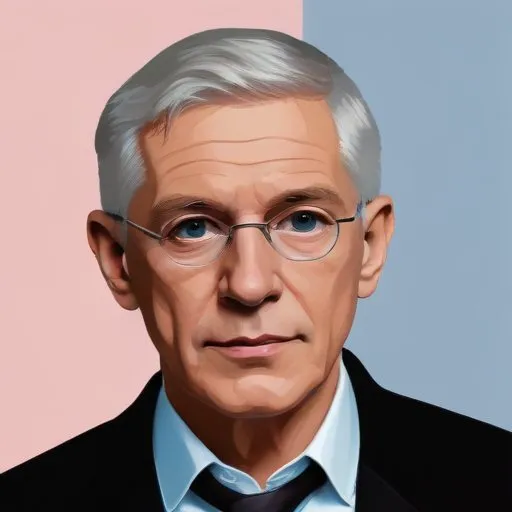
Expressive and innovative artist known for bold, vibrant portraits and landscapes that captured the essence of early 20th-century Vienna's avant-garde scene.
Richard Gerstl was an Austrian painter and draughtsman known for his emotionally charged, psychologically insightful portraits that pierced the souls of his subjects. Despite his lack of critical acclaim during his lifetime, Gerstl's bold and expressive style has left an indelible mark on the art world.
Born on September 14, 1883, in Vienna, Austria, Gerstl grew up in a prosperous civil family. His father, Emil, was a Jewish merchant, and his mother, Maria, was a non-Jewish woman. From a young age, Gerstl's fascination with art was evident, much to the dismay of his father, who had envisioned a more traditional career path for his son.
This criticism did not deter Gerstl, who continued to develop his unique style, eventually studying under Simon Hollósy in Nagybánya during the summers of 1900 and 1901.
In 1906, Gerstl's life took a dramatic turn when he began an affair with Mathilde Schoenberg, the wife of renowned composer Arnold Schoenberg. This scandalous relationship led to a deep sense of turmoil and despair, ultimately contributing to Gerstl's tragic suicide on November 4, 1908, at the age of 25.
Gerstl's body of work, though small, showcases his remarkable talent for capturing the emotional complexity of his subjects. His portraits exude a sense of intimacy, vulnerability, and raw emotion, making him a standout in the early 20th-century art scene.
In the end, Gerstl's life serves as a poignant reminder that true art often emerges from the darkest corners of the human experience. His legacy continues to inspire and captivate art lovers to this day, a testament to the power of his bold and unapologetic vision.
"One must create for oneself, or one will perish." – Richard Gerstl
Gerstl's short but tumultuous life coincided with a period of great cultural and artistic upheaval in Vienna. His work, though often overlooked during his lifetime, has come to be appreciated as a bridge between the Vienna Secession and the Expressionist movements.
Today, Gerstl's paintings are held in high esteem, with many of his works displayed in prominent museums and galleries, including the Leopold Museum in Vienna.
Born in 1890
Austrian soldier and painter who captured the intensity of human emotion through bold, expressive portraits and landscapes, often exploring themes of death, sexuality, and the human condition.
Born in 1862
Austrian Symbolist master of opulent, gold-leaf adorned paintings and illustrations that explored the human form, often with erotic undertones. His works are synonymous with Viennese Art Nouveau.
Born in 1886
Austrian-Swiss artist who pioneered Expressionism through vibrant, emotive paintings and plays that explored the human condition. His works often featured distorted forms and bold colors.
Born in 1877
Austrian author and illustrator of fantastical and often unsettling stories, known for his pioneering work in the field of fantastical literature and his eerie, dreamlike illustrations.
Born in 1880
A German soldier-turned-painter who pioneered Expressionism, capturing the emotional essence of animals and landscapes in vibrant, abstracted forms. His work continues to inspire artists and art lovers alike.
Born in 1866
A pioneer of abstract art, creating vibrant, expressive works that explored the emotional and spiritual properties of color, and wrote extensively on art theory.
Born in 1879
A Swiss-German artist and educator who blended fantasy and reality in his vibrant, whimsical paintings, exploring the emotional and expressive qualities of color. His unique style has inspired generations of artists.
Born in 1867
A pioneering Expressionist artist, known for vibrant, emotive paintings and prints that explored the human condition, often with a focus on spirituality and the natural world.
