


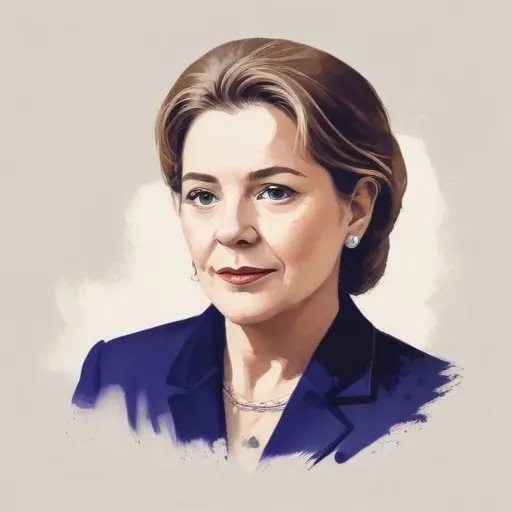
A Dutch journalist-turned-politician who served as Minister of Justice, known for her tough stance on immigration and integration policies. She sparked controversy with her proposals to ban burqas and restrict citizenship.
Rita Verdonk is a renowned Dutch politician and businesswoman, best known for her influential role in shaping the country's integration policies, particularly during her tenure as Minister for Integration and Asylum Affairs. Her unwavering stance on immigration and integration issues has made her a household name in the Netherlands.
Born on October 18, 1955, in the Netherlands, Verdonk attended a Gymnasium in Utrecht, where she developed a strong foundation in law and criminology. She later pursued her higher education at Radboud University Nijmegen, graduating with a Bachelor of Criminal Justice degree in 1979 and a Master of Criminal Justice degree in 1983.
Verdonk's career spans over three decades, with notable stints as a civil servant, management consultant, and politician. She worked as a director of the department of State Security of the Domestic Security Service (BVD) from 1996 to 1999, and later as a management consultant for KPMG and Atos from 1999 to 2003.
In 2003, she was appointed as Minister for Integration and Asylum Affairs in the Cabinet Balkenende II, a position she held until 2006. During her tenure, she implemented several integration policies, including the introduction of compulsory integration courses for immigrants.
In 2006, Verdonk announced her candidacy to succeed Jozias van Aartsen as the leader of the People's Party for Freedom and Democracy (VVD). Although she lost the leadership election to Mark Rutte, her political ambitions remained unwavering.
The same year, she became embroiled in the Verdonk-Ayaan Hirsi Ali controversy, which led to the fall of the Cabinet Balkenende II. Verdonk continued to serve in a demissionary capacity until the cabinet was replaced by the caretaker Cabinet Balkenende III.
In 2007, Verdonk founded Proud of the Netherlands (TON), a political party that aimed to promote Dutch identity and values. Although the party did not achieve significant electoral success, it remains an indication of Verdonk's commitment to her political ideals.
In 2022, Verdonk was elected as a municipal councillor of The Hague, a position she currently holds. Her continued involvement in Dutch politics is a testament to her dedication to her country and its people.
Rita Verdonk's career has been marked by controversy and criticism, but also by her unwavering commitment to her political ideals. Her integration policies, although contentious, have contributed to a national debate on immigration and identity. As a pioneering female politician in the Netherlands, Verdonk's legacy serves as an inspiration to women in politics.
59 Years Old
The Prime Minister of the Netherlands, leading the country since 2010, known for his economic policies and handling of the European migrant crisis.
70 Years Old
A Dutch jurist and politician who served as Prime Minister of the Netherlands from 2002 to 2010, known for his Christian democratic views and leadership during a period of significant social and economic change.
87 Years Old
Led the Netherlands as Prime Minister from 1994 to 2002, implementing significant economic reforms and guiding the country's integration into the European Union. He's also known for his role in shaping the country's social and economic policies.
95 Years Old
A Dutch journalist and politician who served as Deputy Prime Minister of the Netherlands, known for his progressive views and leadership in the Democrats 66 party. He played a key role in shaping the country's social and economic policies.
Born in 1919
A Dutch journalist, economist, and politician who served as Deputy Prime Minister of the Netherlands, known for his progressive policies and efforts to reduce economic inequality. He played a key role in shaping the country's social and economic landscape.
87 Years Old
The Prime Minister of the Netherlands from 1982 to 1994, known for leading the country through a period of economic growth and implementing significant welfare state reforms. He also served as the United Nations High Commissioner for Refugees from 2001 to 2005.
