


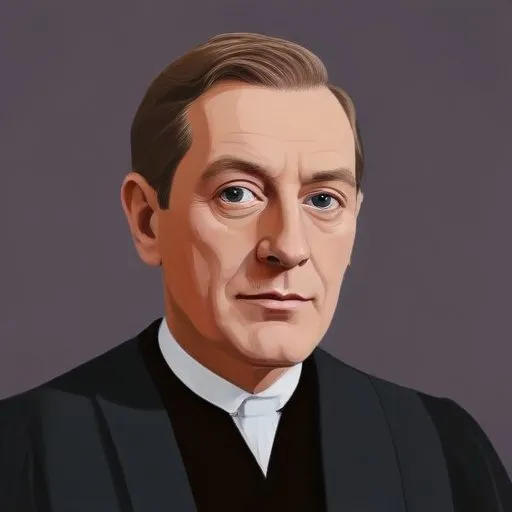
A British lawyer and politician who played a key role in establishing the League of Nations and won the Nobel Peace Prize in 1937 for his efforts to promote international cooperation and peace. He was a strong advocate for disarmament and collective security.
Robert Cecil, 1st Viscount Cecil of Chelwood, is renowned for his pivotal role in shaping the modern international system, particularly through his instrumental contribution to the creation of the League of Nations. This distinguishable British lawyer, politician, and diplomat was awarded the Nobel Peace Prize in 1937 for his tireless efforts in promoting international cooperation and collective security.
Born on September 14, 1864, in London, Cecil was the sixth child and third son of Robert Gascoyne-Cecil, 3rd Marquess of Salisbury, who would later serve as Prime Minister of the United Kingdom three times. Cecil's early education took place at home until he was thirteen, after which he spent four years at Eton College. He then pursued legal studies at University College, Oxford, where he developed a passion for debating.
Cecil's first foray into politics was as private secretary to his father during the latter's term as Prime Minister from 1886 to 1888. In 1887, he was called to the bar by the Inner Temple and began practicing civil law, including work in Chancery and parliamentary practice. His exceptional skills as a lawyer led to his appointment as a Queens Counsel in 1899.
Cecil's involvement in international politics began in earnest during World War I, when he served as Parliamentary Under-Secretary of State for Foreign Affairs. It was during this period that he developed a deep conviction in the need for international cooperation to prevent future conflicts. Cecil played a crucial role in the creation of the League of Nations, serving as a British delegate to the Paris Peace Conference in 1919 and later as Deputy Leader of the British Delegation to the League's Assembly from 1920 to 1922.
In 1937, Cecil was awarded the Nobel Peace Prize for his unwavering commitment to the principles of international cooperation and collective security. During the 1930s, he continued to advocate for theLeague of Nations, even as the organization faced significant challenges and criticism. Cecil's later life was marked by his continued involvement in international affairs, including his role as a vocal critic of appeasement policies towards Nazi Germany.
Throughout his life, Cecil demonstrated a profound commitment to the principles of internationalism, believing that collective action was essential to preventing war and promoting peace. His advocacy for the League of Nations was rooted in his conviction that sovereign states had a responsibility to cooperate and work towards a more peaceful and stable world.
Robert Cecil's legacy extends far beyond his role as a Nobel laureate or his instrumental contribution to the creation of the League of Nations. His tireless advocacy for international cooperation has inspired generations of diplomats, politicians, and scholars. Today, his commitment to collective security and internationalism remains an integral part of the United Nations' mandate, a testament to the enduring relevance of his ideas and ideals.
Cecil's personal life was marked by significant milestones, including his marriage to Lady Eleanor Lambton in 1889, with whom he had three children. He was also known for his close relationships with prominent figures, including his cousin, Arthur Balfour, and his friendship with Lord Quickswood, with whom he shared a strong bond.
Robert Cecil's life and work should be understood within the context of the tumultuous early twentieth century, a period marked by two devastating world wars and the emergence of new international institutions. His commitment to international cooperation and collective security has left an indelible mark on modern international relations, inspiring subsequent generations of diplomats, politicians, and scholars.
Born in 1869
The Prime Minister who infamously appeased Nazi Germany with the Munich Agreement, hoping to avoid war, but ultimately contributing to its outbreak. He's a symbol of failed diplomacy and naivety in the face of aggression.
Born in 1871
Prolific writer of historical novels and adventure stories, also a talented landscape painter.
Born in 1897
A British politician who served as Prime Minister from 1955 to 1957, known for his role in the Suez Crisis and his diplomatic efforts during the Cold War.
Born in 1883
Led the Labour Party to a landslide victory in 1945, implementing significant social and economic reforms, including the creation of the National Health Service. He played a crucial role in shaping post-war Britain.
Born in 1867
A conservative leader who served as Prime Minister three times, known for his role in navigating Britain through economic crises and advocating for imperial protectionism.
Born in 1866
A Scottish journalist and politician who served as the first Labour Party Prime Minister of the United Kingdom, leading the country through significant economic and social reforms. He is also known for his efforts to maintain peace in Europe during the interwar period.
Born in 1863
A Welsh lawyer and politician who served as Prime Minister of the United Kingdom, leading the country through World War I and introducing key social reforms. He's known for his charismatic leadership and progressive policies.
