


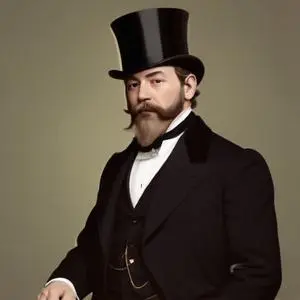
A prominent British politician who served as Prime Minister three times, leading the country through significant social and economic changes during the late 19th century. He's known for his conservative policies and imperialist views.
Robert Gascoyne-Cecil, 3rd Marquess of Salisbury, was a British statesman and Conservative politician who served as Prime Minister of the United Kingdom three times for a total of over thirteen years, leaving an indelible mark on British politics and foreign policy.
Salisbury is perhaps best known for his unwavering commitment to the policy of "splendid isolation," avoiding alignments or alliances that might limit Britain's autonomy and flexibility in international relations.
Born on February 3, 1830, Salisbury was first elected to the House of Commons in 1854, where he quickly made a name for himself as a talented orator and skilled politician.
He served as Secretary of State for India in Lord Derby's Conservative government from 1866 to 1867 and later returned to the position in 1874 under Disraeli.
In 1878, Salisbury was appointed Foreign Secretary, where he played a leading role in the Congress of Berlin, a pivotal moment in modern European history.
Following Disraeli's death in 1881, Salisbury emerged as the Conservative leader in the House of Lords, with Sir Stafford Northcote leading the party in the Commons.
Salisbury's biggest achievement as Prime Minister was obtaining the majority of new territory in Africa during the Scramble for Africa, avoiding a war or serious confrontation with other European powers.
He successfully navigated the complex web of international relations, maintaining Britain's independence and influence while avoiding costly entanglements.
Salisbury led Britain to victory in the Boer War, a bitter and controversial conflict that showcased his leadership skills and resolve.
He remained Prime Minister until 1902, when he relinquished the premiership to his nephew, Arthur Balfour, and passed away in 1903.
Salisbury's commitment to splendid isolation was rooted in his distrust of European entanglements and his belief in Britain's unique role in world affairs.
He was a staunch defender of British interests and sovereignty, often taking a pragmatic approach to international relations.
Salisbury's legacy continues to shape British foreign policy, with his commitment to splendid isolation influencing generations of policymakers.
His pragmatic approach to international relations remains a valuable lesson for modern leaders, offering a unique perspective on the complexities of global politics.
"The commonest error in politics is sticking to the carcass of dead policies."
"The great object of the Government is the security of the State."

Explore the key events and milestones of Salisbury's life and career in this interactive timeline.
Salisbury's leadership and policies continue to shape our understanding of British history and foreign policy, offering valuable lessons for modern policymakers.
As a statesman of unwavering conviction, he remains an important figure in British history, worthy of continued study and admiration.
Born in 1804
A skilled politician who served as Prime Minister of the United Kingdom, known for his influential role in shaping the country's politics and economy during the 19th century.
Born in 1819
The monarch who ruled the British Empire for 63 years, overseeing the Industrial Revolution and expanding the empire's reach, earning the nickname "the Grandmother of Europe".
Born in 1871
Prolific writer of historical novels and adventure stories, also a talented landscape painter.
Born in 1863
A Welsh lawyer and politician who served as Prime Minister of the United Kingdom, leading the country through World War I and introducing key social reforms. He's known for his charismatic leadership and progressive policies.
Born in 1867
A conservative leader who served as Prime Minister three times, known for his role in navigating Britain through economic crises and advocating for imperial protectionism.
Born in 1866
A Scottish journalist and politician who served as the first Labour Party Prime Minister of the United Kingdom, leading the country through significant economic and social reforms. He is also known for his efforts to maintain peace in Europe during the interwar period.
