


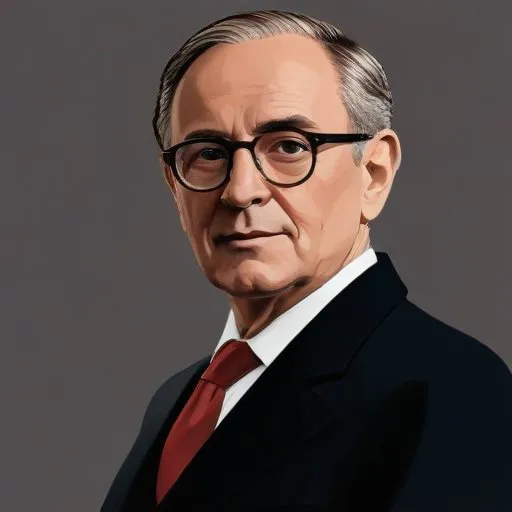
An economist and historian who explored the intersection of economics and social history, known for his accessible and engaging writings on capitalism and its effects on society.
Robert Heilbroner, a renowned American economist and historian of economic thought, is best known for his seminal work, The Worldly Philosophers: The Lives, Times and Ideas of the Great Economic Thinkers, a comprehensive survey of the lives and contributions of famous economists such as Adam Smith, Karl Marx, and John Maynard Keynes.
This 1953 magnum opus not only cemented Heilbroner's reputation as a leading economist but also showcased his unique ability to weave together the disciplines of history, economics, and philosophy, earning him the moniker "worldly philosopher".
Heilbroner was born on March 24, 1919, in New York City, to a wealthy German Jewish family. His father, Louis Heilbroner, founded the men's clothing retailer Weber & Heilbroner.
Heilbroner graduated from Harvard University in 1940 with a summa cum laude degree in philosophy, government, and economics. During World War II, he served in the United States Army and worked at the Office of Price Control under the guidance of John Kenneth Galbraith, a highly celebrated and controversial Institutionalist economist.
After World War II, Heilbroner worked briefly as a banker before entering academia in the 1950s as a research fellow at the New School for Social Research in New York. During this period, he was heavily influenced by the German economist Adolph Lowe, a prominent representative of the German Historical School.
In 1963, Heilbroner earned a Ph.D. in Economics from the New School for Social Research, where he was subsequently appointed Norman Thomas Professor of Economics in 1971, a position he held for over twenty years. He mainly taught History of Economic Thought courses at the New School.
Heilbroner's other notable works include The Future as History (1959), The Great Ascent (1963), and The Crisis of Vision in Modern Economic Thought (1975). These works demonstrate his ability to engage with complex economic ideas and present them in an accessible and engaging manner.
Heilbroner's work has had a profound impact on modern society, shaping the way we think about economics and its relationship to philosophy, history, and politics. His emphasis on the importance of understanding the historical context of economic thought has influenced generations of economists, historians, and social theorists.
Heilbroner's philosophical contributions lie in his ability to integrate insights from multiple disciplines, offering a nuanced understanding of the complex interactions between economic systems, social structures, and individual agency. His work has inspired a new wave of economists, philosophers, and historians to explore the intersections of economics, politics, and culture.
Robert Heilbroner's legacy extends far beyond his impressive body of work. He has inspired a new generation of scholars to engage with the complexities of economic thought, encouraging them to adopt a more holistic approach that incorporates history, philosophy, and politics.
As a "worldly philosopher", Heilbroner's work continues to shape our understanding of the intricate relationships between economic systems, social structures, and individual agency, ensuring that his ideas remain as relevant today as they were during his lifetime.
Born in 1915
A renowned economist and academic who made significant contributions to the field of economics, particularly in the areas of macroeconomics and international trade. He was awarded the Nobel Prize in Economics in 1970.
Born in 1883
A pioneering economist who revolutionized modern economic theory with his groundbreaking ideas on government intervention and fiscal policy, shaping global economic policies.
Born in 1912
A Nobel Prize-winning economist who championed free market capitalism and limited government intervention, known for his advocacy of laissez-faire economics and influential writings on monetary policy.
Born in 1883
A pioneer of innovation theory, he's credited with coining the term "creative destruction" to describe how new technologies and businesses disrupt existing ones, driving economic growth and progress.
Born in 1908
A renowned economist and diplomat who served as the 7th United States Ambassador to India, known for his influential works on economics, particularly "The Affluent Society" and "The New Industrial State".
Born in 1926
Former Chairman of the Federal Reserve, guiding the US economy through periods of growth and crisis, and known for his influence on monetary policy.
Born in 1924
A Nobel Prize-winning economist who developed a growth model that showed technological progress is the primary driver of economic growth, and is known for his work on the theory of economic growth.
Born in 1920
Developed econometric models that accurately predicted economic trends and fluctuations, earning him the Nobel Prize in Economics in 1980.
