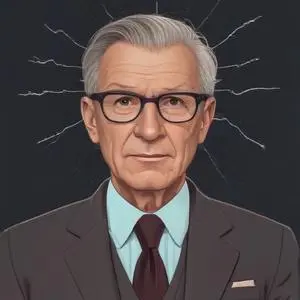
Robert J. Van de Graaff: The Pioneer of High-Voltage Generation
The Inventor of the Van de Graaff Generator
Robert J. Van de Graaff is renowned for his groundbreaking design and construction of high-voltage Van de Graaff generators, which revolutionized the field of physics. His innovative work enabled the production of extremely high voltages, paving the way for significant advancements in various scientific disciplines.
Early Life and Education
Born on December 20, 1901, in Tuscaloosa, Alabama, Van de Graaff was the youngest of four brothers in a family of Dutch descent. His father, Adrian Sebastian Bass Van de Graaff, was a circuit judge, and his great-grandfather, Robert Jemison Jr., was a prominent figure in Alabama's history. Van de Graaff's academic pursuits took him to the University of Alabama, where he earned his B.S. in mathematics in 1922 and M.S. in mechanical engineering in 1923. He later attended the Sorbonne in 1925 and Oxford University, where he earned a second B.S. and a D.Phil. in 1928 under the guidance of John Sealy Townsend.
The Genesis of the Van de Graaff Generator
During his time at Oxford, Van de Graaff developed his passion for high-voltage research, which ultimately led to the creation of his iconic generator. In 1929, he successfully built his first generator, capable of producing 80,000 volts. This innovation propelled him to further his research, and by 1933, he had constructed a larger generator that could generate an astonishing 7 million volts.
Academic and Professional Career
Van de Graaff's academic career spanned several prestigious institutions, including Princeton University, where he worked from 1929 to 1931, and the Massachusetts Institute of Technology (MIT), where he became an associate professor in 1934. During World War II, he served as the director of the High Voltage Radiographic Project, and after the war, he co-founded the High Voltage Engineering Corporation (HVEC) in 1946.
Awards and Honors
Van de Graaff's contributions to the field of physics earned him several accolades, including the prestigious Elliott Cresson Medal in 1936. His work had a profound impact on various scientific disciplines, from nuclear physics to medicine, and his legacy continues to inspire researchers and scientists today.
Legacy and Impact
Van de Graaff's invention of the high-voltage generator has had a lasting impact on modern society. His work has enabled significant advancements in fields such as cancer treatment, materials modification, and high-energy physics research. The Van de Graaff generator has become an indispensable tool in numerous scientific applications, cementing Van de Graaff's status as a pioneer in the field of high-voltage research.
Personal and Professional Milestones
- Developed the first Van de Graaff generator in 1929
- Constructed a generator capable of producing 7 million volts in 1933
- Became an associate professor at MIT in 1934
- Awarded the Elliott Cresson Medal in 1936
- Co-founded the High Voltage Engineering Corporation in 1946
Trivia and Fun Facts
- Van de Graaff's three older brothers were all All-Southern college football players for the Alabama Crimson Tide
- He was a founding member of The Castle Club, later known as Mu Chapter of Theta Tau, at the University of Alabama
- Van de Graaff's great-grandfather, Robert Jemison Jr., was a prominent figure in Alabama's history
Robert J. Van de Graaff's remarkable achievements have left an indelible mark on the scientific community, and his invention of the Van de Graaff generator continues to inspire innovation and discovery.
FAQ
What is Robert J. Van de Graaffs most notable scientific contribution?
Robert J. Van de Graaff is best known for inventing the Van de Graaff generator, a type of electrostatic generator that produces high-voltage electrical discharges.
What are some of Robert J. Van de Graaffs notable research areas?
Van de Graaffs research focused on high-voltage physics, nuclear physics, and particle accelerators, contributing to significant advancements in these fields.
How did Robert J. Van de Graaffs invention impact the field of physics?
The Van de Graaff generator has had a significant impact on the field of physics, enabling the study of high-energy particles and contributing to breakthroughs in nuclear physics and particle accelerators.
What are some of Robert J. Van de Graaffs notable awards and recognition?
Van de Graaff received numerous awards, including the Elliott Cresson Medal and the Tom W. Bonner Prize in Nuclear Physics.
What is Robert J. Van de Graaffs legacy in the scientific community?
Van de Graaffs legacy lies in his contributions to the field of physics, inspiring future generations of scientists and shaping the course of scientific research.