


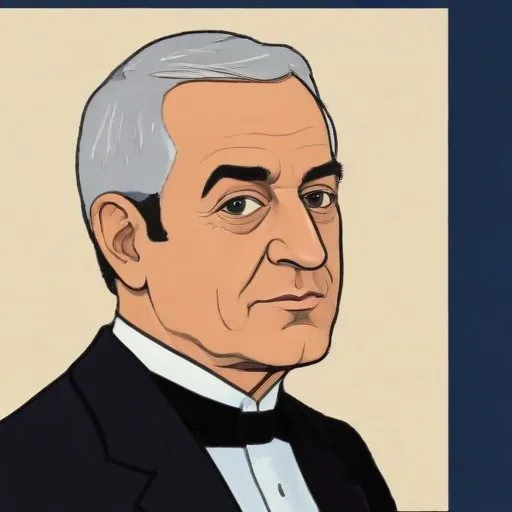
A Greek-American historian and author, renowned for his insightful writings on American foreign policy, international relations, and the role of the United States in the world.
As a leading advocate of liberal interventionism and a vocal critic of U.S. foreign policy, Robert Kagan has left an indelible mark on the world of international relations. His influential writings and advisory roles have shaped the discourse on global politics, earning him recognition as a prominent neoconservative scholar.
Born on September 26, 1958, in Athens, Greece, to a family of esteemed academics, Kagan's life has been marked by a passion for history and politics. His father, Donald Kagan, was a renowned historian and professor at Yale University, while his brother, Frederick, is a military historian and author.
Kagan's academic credentials are impressive, with a B.A. in history from Yale University (1980), a Master of Public Policy from Harvard's Kennedy School of Government, and a Ph.D. in American history from American University in Washington, D.C. His early career was marked by stints as a foreign policy advisor to Representative Jack Kemp and speechwriter for Secretary of State George P. Shultz.
Kagan's most significant contribution to the sphere of international relations is his advocacy for liberal interventionism. He believes that the United States has a moral obligation to promote democracy and human rights globally, even if it requires military intervention. This philosophy has been shaped by his experiences as a foreign policy advisor to U.S. Republican presidential candidates and Democratic administrations.
As a co-founder of the Project for the New American Century, a think tank that promotes American global leadership, Kagan has been a vocal critic of isolationism and a proponent of assertive U.S. foreign policy. His writings, both in academic journals and mainstream media outlets like The Washington Post, have been instrumental in shaping public opinion on matters of international relations.
Beyond his academic and professional achievements, Kagan has made headlines for his personal life. He is married to Victoria Nuland, a high-ranking American diplomat who has served as deputy national security advisor and assistant secretary of state. The couple's marriage has been a symbol of bipartisanship, with Kagan having advised Republican presidential candidates and Nuland serving in Democratic administrations.
In 2016, Kagan made a significant political statement by leaving the Republican Party and endorsing Hillary Clinton for president, citing his opposition to Donald Trump's candidacy. This move underscored his commitment to liberal values and his willingness to take a stand against what he perceives as threats to American democracy.
Robert Kagan's influence on modern American foreign policy is undeniable. His advocacy for liberal interventionism has shaped the discourse on global politics, inspiring a new generation of scholars and policymakers. His commitment to promoting democracy and human rights has earned him recognition as a leading voice in the neoconservative movement.
Love him or hate him, Robert Kagan is an intellectual force to be reckoned with. His life's work serves as a testament to the power of ideas in shaping global politics, and his legacy will continue to be felt for generations to come.
82 Years Old
A key architect of the Iraq War, he served as Deputy Secretary of Defense under President George W. Bush and later as President of the World Bank.
85 Years Old
The 46th Vice President of the United States, a powerful and influential figure in American politics, known for his strong conservative stance and role in shaping the country's foreign policy during the War on Terror.
93 Years Old
The 13th United States Secretary of Defense, a high-ranking government official, oversaw the US military during the Iraq War and was known for his controversial decisions and quotes. He's infamous for his "known unknowns" phrase.
71 Years Old
The first African American woman to serve as Secretary of State, she played a crucial role in shaping US foreign policy during a tumultuous period, earning her a lasting legacy in international relations.
Born in 1924
The 41st President of the United States, a decorated war hero and skilled diplomat, led the country through the end of the Cold War and Gulf War. He's known for his foreign policy expertise and "kinder, gentler nation" vision.
73 Years Old
The former Prime Minister of the United Kingdom who led the country through a transformative period, including the Iraq War, and is known for his charismatic leadership and controversial decisions.
89 Years Old
The authoritarian leader who ruled Iraq with an iron fist, notorious for his brutal suppression of dissent and invasion of neighboring countries.
73 Years Old
A Russian politician who has dominated the country's politics for over two decades, known for his authoritarian leadership style and controversial foreign policy decisions.
