


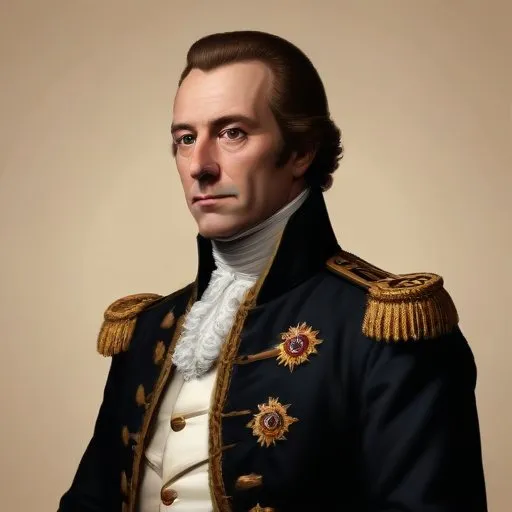
An English colonial administrator and admiral who played a significant role in the early history of Virginia and the American colonies. He was a prominent figure in the Virginia Company and helped establish the Jamestown settlement.
Robert Rich, 2nd Earl of Warwick, was a prominent English naval officer, politician, and peer who commanded the Parliamentarian navy during the tumultuous Wars of the Three Kingdoms. As a staunch Puritan, he played a crucial role in shaping the course of English history, earning him a place among the most influential figures of his time.
Born in May or June 1587, Robert Rich was the eldest son of Robert Rich, 1st Earl of Warwick, and his first wife, Penelope. His parents' marriage was marked by turmoil, with the couple separating soon after his birth and eventually divorcing in 1605. This tumultuous background would later influence Rich's own personal and political affiliations.
Despite the challenges he faced, Rich came from a prominent family with strong connections to the English nobility. His mother, Penelope, was a sister of the Earl of Essex, executed for treason in 1601, making Rich a cousin to the future Parliamentarian general Robert Devereux, 3rd Earl of Essex.
Rich married three times throughout his life, first to Frances Hatton in 1605, with whom he had five children: Anne, Robert, Lucy, Frances, and Charles. After Frances' death in 1623, he married Susan Rowe, daughter of Sir Henry Rowe, Lord Mayor of London, and widow of William Holliday, a wealthy London merchant and chairman of the East India Company. His third marriage, to an unknown woman, occurred sometime before 1646.
As a skilled naval officer, Rich commanded the Parliamentarian navy during the Wars of the Three Kingdoms, playing a crucial role in the conflict. His experience and expertise earned him the respect of his peers and the admiration of his countrymen. Rich's dedication to the Parliamentarian cause was unwavering, and he remained a staunch supporter of the movement throughout his life.
As a Puritan, Rich was deeply committed to his faith and its principles. His strong sense of morality and justice guided his decisions, both personally and politically. Rich's Puritan beliefs also influenced his political affiliations, leading him to support the Parliamentarian cause and oppose the monarchy.
Robert Rich, 2nd Earl of Warwick, left an indelible mark on English history. His bravery, strategic thinking, and unwavering commitment to his cause earned him a place among the most revered figures of his time. As a prominent Parliamentarian and naval officer, Rich's influence extended far beyond his own lifetime, shaping the course of English politics and society for generations to come.
Rich's life and career must be viewed within the context of the Wars of the Three Kingdoms, a period of great turmoil and upheaval in English history. His commitment to the Parliamentarian cause and his Puritan beliefs set him apart from his contemporaries, earning him a unique place in the annals of history. A comparative analysis with his contemporaries, such as Oliver Cromwell and Robert Devereux, 3rd Earl of Essex, reveals a complex web of alliances, rivalries, and shared ideals that shaped the course of English history.
Born in 1552
A Renaissance man who wrote poetry, fought in wars, and explored the New World, introducing potatoes and tobacco to England. He's famous for his daring exploits and romanticized legend.
79 Years Old
Australian Labor Party politician who served as Treasurer of Australia from 1983 to 1991, implementing significant economic reforms. He is credited with modernizing the Australian economy.
Born in 1542
A daring sea captain and privateer who raided Spanish ships and colonies, known for his bravery and cunning during the Elizabethan era.
Born in 1731
A pioneering scientist who discovered hydrogen and determined the density of the Earth, making significant contributions to the fields of chemistry and physics.
