


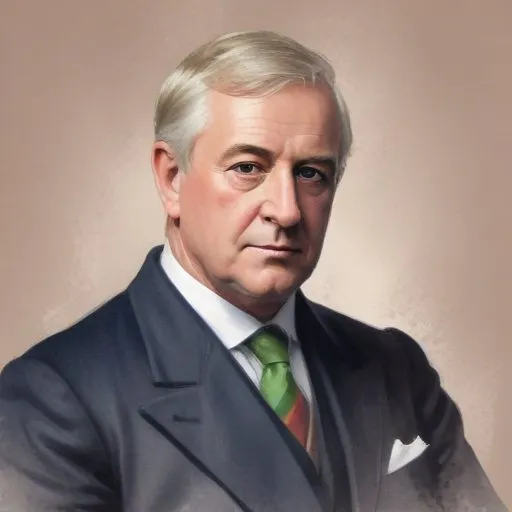
A dominant figure in British politics during the Napoleonic Wars, he played a key role in shaping European diplomacy and was instrumental in the Congress of Vienna. He's also infamous for his role in suppressing Irish rebellion and labor movements.
Robert Stewart, Viscount Castlereagh, was a British statesman and politician who played a pivotal role in shaping Europe's destiny during the tumultuous years of the late 18th and early 19th centuries. As the Foreign Secretary of the United Kingdom from 1812, he masterminded the coalition that defeated Napoleon and was instrumental in negotiating the Treaty of Chaumont, a landmark agreement that brought European powers together against the French Empire.
Born on June 18, 1769, Castlereagh was the son of Robert Stewart, 1st Marquess of Londonderry. He was educated at Cambridge University and entered politics in 1790 as a Member of Parliament for County Down in Ireland. His early career was marked by his support for the British government's efforts to suppress the Irish Rebellion of 1798 and his role in securing passage of the Irish Act of Union in 1800.
Castlereagh's skills as a diplomat and strategist earned him rapid promotion. In 1805, he served as Secretary of State for War under William Pitt and later under the Duke of Portland. Although he was forced to resign in 1809 due to a duel with Foreign Secretary George Canning, he returned to government in 1812 as Foreign Secretary and Leader of the House of Commons under Lord Liverpool.
As Foreign Secretary, Castlereagh played a crucial role in managing the coalition that defeated Napoleon. He organized and financed the European powers, bringing them together at the Treaty of Chaumont in 1814. After Napoleon's second abdication in 1815, Castlereagh worked tirelessly to establish a new European order, attending the Congress of Vienna where he negotiated the Treaty of Paris, which marked the end of the Napoleonic Wars.
Despite his significant contributions to British politics and European diplomacy, Castlereagh's personal life was marked by controversy. He was known for his strong anti-Catholic stance, which led to his opposition to Catholic Emancipation, a position that alienated many of his former allies. His support for harsh measures against reform agitation in the postwar government of Lord Liverpool also made him unpopular.
Castlereagh's political beliefs were shaped by his experiences in Ireland and his exposure to revolutionary France. He recoiled from the democratic politics of his Presbyterian constituents in Ulster and became a strong advocate for monarchical power and the established order.
Castlereagh's legacy is marked by controversy. His support for the Act of Union without Catholic Emancipation was seen as a betrayal by many Irish Catholics. His role in suppressing reform agitation and his anti-Catholic stance made him unpopular among the British public. His duel with George Canning in 1809 further tarnished his reputation.
Despite his controversies, Robert Stewart, Viscount Castlereagh, remains an important figure in British and European history. His diplomatic skills, strategic thinking, and leadership played a crucial role in shaping the course of European politics during a tumultuous era.
Born in 1769
A renowned military leader who defeated Napoleon at the Battle of Waterloo, and later served as Prime Minister of the United Kingdom, shaping the country's politics and history.
Born in 1770
Prime Minister of the United Kingdom during the Napoleonic Wars, leading Britain to victory and establishing the country as a dominant world power. He also reformed the British government and economy.
Born in 1770
A skilled lawyer and politician who served as Prime Minister of the United Kingdom, known for his strong oratory skills and brief but influential tenure in office.
Born in 1788
Romantic poet and playwright celebrated for passionate, expressive works that explored themes of love, freedom, and the human condition.
Born in 1769
A French military leader who rose to prominence during the French Revolution and became Emperor of France, known for his military conquests and reorganization of Europe. He is also famous for his Napoleonic Code, which remains a foundation of modern law.
Born in 1804
A skilled politician who served as Prime Minister of the United Kingdom, known for his influential role in shaping the country's politics and economy during the 19th century.
Born in 1809
A British statesman who served as Prime Minister four times, known for his liberal policies and efforts to reform the British Empire. He's also famous for his rivalry with Benjamin Disraeli.
