


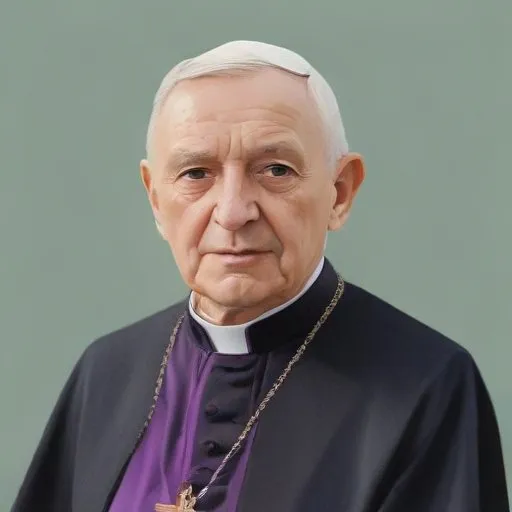
Anglican archbishop who played a key role in the Northern Ireland peace process, particularly in the 1980s and 1990s, and was a strong advocate for ecumenism and social justice.
Robin Eames, Baron Eames, is a renowned Anglican bishop and life peer, best known for his remarkable tenure as Primate of All Ireland and Archbishop of Armagh from 1986 to 2006. Throughout his distinguished career, Eames has been a beacon of hope and reconciliation, working tirelessly to bridge the divide between Protestant and Catholic communities in Ireland.
Born on April 27, 1936, Eames is the son of a Methodist minister. His early years were spent in Larne, before his family moved to Belfast, where he was educated at the prestigious Belfast Royal Academy and Methodist College Belfast. He later pursued his higher education at Queen's University of Belfast, graduating with an LL.B. (Upper Second Class Honours) in 1960 and subsequently earning a Ph.D. degree in ecclesiastical law and history in 1963.
Eames turned down a career in law to pursue ordination in the Church of Ireland. He embarked on a three-year course at the divinity school of Trinity College, Dublin in 1960. After completing his studies, he was appointed curate assistant at Bangor Parish Church in 1963. Three years later, he became the rector of St. Dorothea's in Belfast.
In 1966, Eames married Christine Daly, and during his time at St. Dorothea's, he developed a coffee bar ministry among young people. However, his work was interrupted by The Troubles, a period of sectarian violence and unrest in Northern Ireland. Despite the challenges, Eames remained committed to his ministry and went on to play a crucial role in promoting reconciliation and understanding between Protestant and Catholic communities.
Eames' dedication to his faith and his community has been recognized with several awards and honors. In 1986, he was elected as the Archbishop of Armagh and Primate of All Ireland, a position he held until 2006. He was also appointed as a life peer in 2007, taking his seat in the House of Lords as Baron Eames, of Armagh.
Robin Eames' life and work have had a profound impact on Ireland and beyond. His commitment to reconciliation and understanding has inspired countless individuals and communities. Through his leadership and ministry, Eames has helped to build bridges between Protestant and Catholic communities, promoting a message of hope and peace in a region torn apart by sectarian violence.
Robin Eames' life and work are set against the backdrop of a tumultuous period in Irish history. The Troubles, which lasted from the late 1960s to the late 1990s, saw widespread sectarian violence and unrest in Northern Ireland. Eames' leadership and ministry during this time helped to promote understanding and reconciliation between Protestant and Catholic communities, paving the way for a more peaceful and harmonious future.
Eames' commitment to reconciliation and understanding sets him apart from many of his contemporaries. His willingness to engage with and listen to the concerns of both Protestant and Catholic communities has earned him the respect and admiration of people from all walks of life. In an era marked by division and strife, Eames has been a beacon of hope and a symbol of the power of faith to bring people together.
One of Eames' most notable relationships was with his Catholic counterpart, Edward Daly. The two men formed a close bond, with Eames inviting Daly to his consecration as bishop in 1975. This groundbreaking gesture marked a significant milestone in the development of interfaith relations in Ireland.
Eames' life and work have had a subtle but significant impact on popular culture. His commitment to reconciliation and understanding has inspired countless individuals, from artists and writers to musicians and filmmakers. His story serves as a powerful reminder of the importance of faith, compassion, and forgiveness in the face of adversity.
As Ireland looks to the future, the legacy of Robin Eames will continue to play a vital role in shaping the country's path forward. His commitment to reconciliation and understanding will serve as a beacon of hope, inspiring future generations to work towards a more peaceful and harmonious society.
95 Years Old
A prominent religious leader and human rights advocate who fought against apartheid and racism, known for his tireless efforts to promote equality and forgiveness.
76 Years Old
A former Archbishop of Canterbury and prominent theologian, known for his progressive views on social issues and his efforts to promote interfaith dialogue.
90 Years Old
A prominent leader of the Church of England, serving as Archbishop of Canterbury from 1991 to 2002, known for his efforts to modernize the church and promote interfaith dialogue.
Born in 1921
The 102nd Archbishop of Canterbury, a prominent leader of the Church of England, known for his efforts to promote unity and understanding among Christians and his role in shaping the church's stance on social issues.
Born in 1909
The 101st Archbishop of York, a prominent figure in the Church of England, known for his efforts to modernize the church and his role in the ordination of women as priests.
