


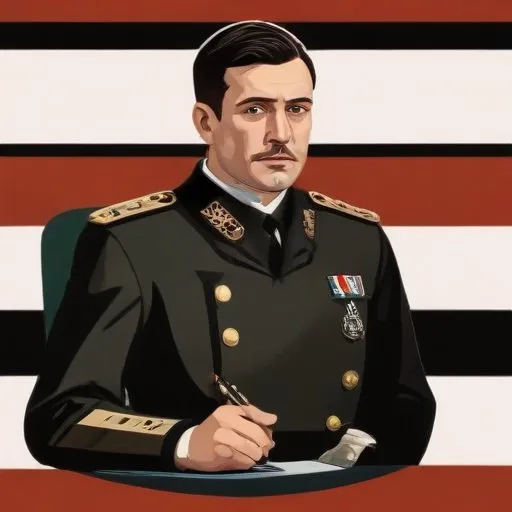
A ruthless and notorious judge who presided over the Nazi's People's Court, sentencing thousands to death during World War II, earning him the nickname "Hanging Judge".
Roland Freisler was a German jurist, judge, and politician who played a instrumental role in the Nazification of Germany's legal system, earning him a notorious reputation as the President of the People's Court from 1942 to 1945. He is infamous for his aggressive personality, humiliating defendants, and frequent use of the death penalty in sentencing.
Roland Freisler was born on October 30, 1893, in Celle, Lower Saxony, to Julius Freisler, an engineer and teacher, and Charlotte Auguste Florentine Schwerdtfeger. He was baptized as a Protestant and had two younger brothers, Oswald and another who became a doctor. Freisler attended the Wilhelmsgymnasium Kassel and received his Abitur in 1912, graduating at the top of his class.
Freisler's law studies at Kiel University were interrupted by the outbreak of World War I in 1914. He enlisted as a Fahnenjunker officer cadet with the 167th Infantry Regiment in Kassel and saw active service in the German Imperial Army. By 1915, he was a Leutnant and was awarded the Iron Cross 2nd class for heroism in action. After being wounded in action on the eastern front, he was taken as a prisoner of war by the Russians.
After the war, Freisler joined the Nazi Party and quickly rose through the ranks, becoming the State Secretary of the Reich Ministry of Justice from 1934 to 1942. He was a prominent ideologist of Nazism, influencing the Nazification of Germany's legal system. In 1941, he redefined murder in German law, which survived even after the creation of the Federal Republic in 1949.
In 1942, Freisler attended the Wannsee Conference, a secret meeting of high-ranking Nazi officials, where the plan for the "Final Solution" was discussed. This event marked the beginning of the Holocaust, one of the darkest chapters in human history.
In 1942, Freisler was appointed President of the People's Court, overseeing the prosecution of political crimes. He became notorious for his aggressive personality, humiliating defendants, and frequent use of the death penalty in sentencing. His court was responsible for sentencing thousands of people to death, earning him the nickname "The Hanging Judge."
Roland Freisler's legacy is marked by his instrumental role in the Nazification of Germany's legal system and his contribution to the atrocities of the Holocaust. His aggressive and harsh approach to justice resulted in the deaths of thousands of innocent people. His dark legacy serves as a reminder of the dangers of unchecked power and the importance of upholding human rights and dignity.
Freisler was married to Marion Russegger, and they had two sons. During an Allied bombing raid on Berlin in 1945, Freisler was killed while trying to flee the destroyed courthouse.
Born in 1889
The dictator of Nazi Germany, responsible for the genocide of six million Jews and millions of other people during World War II, and infamous for his extreme nationalist and anti-Semitic ideology.
Born in 1893
A high-ranking Nazi official, he was a decorated World War I fighter pilot and later became a prominent politician, serving as Minister President of Prussia. He's infamous for his role in the Nazi regime and war crimes trials.
Born in 1897
A mastermind of Nazi propaganda, he crafted a persuasive narrative that fueled the Third Reich's rise to power, leaving a lasting impact on the world.
Born in 1900
Leading the SS and Gestapo, he oversaw the Nazi regime's brutal security apparatus and implemented the "Final Solution," orchestrating the genocide of six million Jews during World War II.
Born in 1893
A German diplomat who served as the Nazi regime's Foreign Minister, orchestrating key alliances and treaties that led to World War II. He was a close associate of Adolf Hitler and played a crucial role in shaping Nazi foreign policy.
Born in 1876
A German naval leader who played a key role in the Kriegsmarine during World War II, overseeing the German U-boat fleet and naval operations. He was a close advisor to Adolf Hitler and implemented the German naval strategy during the war.
Born in 1891
A German naval commander who led the U-boat fleet during World War II and briefly served as President of Germany after Hitler's death, known for his role in the war and its aftermath.
Born in 1894
A German sailor-turned-politician who played a key role in the Nazi regime, particularly in organizing forced labor during World War II. He was later tried and executed for war crimes.
