


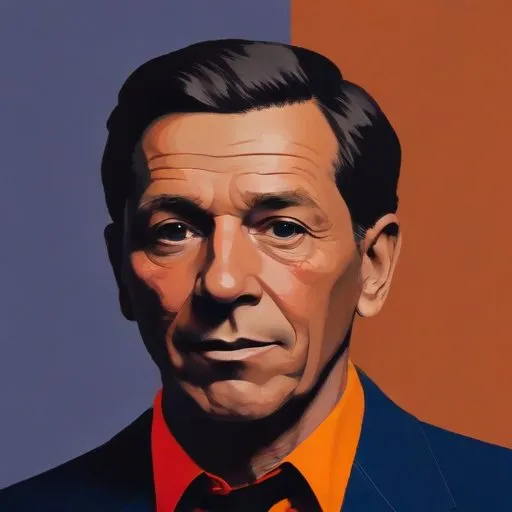
A pioneering figure in minimalist sculpture, creating large-scale, geometric forms that explore space and materiality. His work blurred the lines between art and architecture.
Ronald Bladen, a Canadian-born American painter and sculptor, is renowned for his large-scale, avant-garde sculptures that revolutionized the art world in the mid-20th century. His innovative approach, influenced by European Constructivism, American Hard-Edge Painting, and sculptors like Isamu Noguchi and David Smith, paved the way for the Minimalist movement.
Charles Ronald Wells Bladen was born on July 13, 1918, in Vancouver, Canada, to British immigrants Muriel Beatrice Tylecote and Kenneth Bladen. The family moved to Washington state in 1922 and later returned to Victoria, British Columbia in 1932. Bladen's artistic inclination emerged at a young age, and by ten, he began drawing intensively, inspired by the works of Titian, Picasso, and Matisse.
In 1937, Bladen enrolled in the Vancouver School of Art, where he honed his skills until 1939. He then moved to San Francisco, enrolling in the California School of Fine Arts in 1939.
In San Francisco, Bladen's artistic style began to take shape. However, in 1941, he was drafted but later declared unfit for service. During this period, he worked as a ship's welder at the navy dockyards, acquiring skills that would later support him as a toolmaker.
In 1946, Bladen traveled to Tijuana, Mexico, New Orleans, and New York on a grant from the San Francisco Art Association. This journey marked a significant turning point in his artistic career, exposing him to new influences and relationships that would shape his artistic vision.
In 1956, Bladen moved to New York, where he became a key figure in the emerging Minimalist movement. He befriended writers like Jack Kerouac, Henry Miller, and Allen Ginsberg, and his association with artists like Al Held, George Sugarman, and Nicholas Krushenick led to the formation of the Brata Gallery cooperative in 1957.
During this period, Bladen's paintings underwent a significant transformation, reflecting his growing interest in abstraction and the elimination of extraneous elements. His sculptures, characterized by simplicity, monumentality, and industrial materials, began to take center stage, influencing a new generation of artists, including Carl Andre, Donald Judd, and Sol LeWitt.
Ronald Bladen's contribution to the development of Minimalist art is profound. His innovative sculptures, which emphasized simplicity, materiality, and spatial relationships, paved the way for a new wave of artists who sought to challenge traditional notions of art.
Bladen's influence extends beyond the art world, with his emphasis on simplicity, functionality, and industrial materials influencing modern design, architecture, and even music. His legacy can be seen in the work of contemporary artists, architects, and designers who continue to push the boundaries of Minimalism.
Ronald Bladen's pioneering vision, innovative sculptures, and influence on the development of Minimalism have cemented his place as one of the most important artists of the 20th century.
Born in 1903
A pioneer of abstract expressionism, creating bold, rectangular color fields that evoke emotions and spark introspection. His works are a testament to the power of art to transcend language and culture.
Born in 1905
A pioneer of Abstract Expressionism, creating bold, color-field paintings that evoke emotions and spirituality. His iconic "zip" paintings feature vibrant, vertical stripes that seem to pulse with energy.
Born in 1904
A pioneering abstract expressionist, creating large-scale, gestural paintings that explored the human experience and the American West. Known for his bold, expressive brushstrokes and vibrant color palette.
Born in 1925
A pioneer of pop art, combining found objects and images to create innovative, thought-provoking works that blurred the lines between art and everyday life.
96 Years Old
A pioneer of pop art, creating enigmatic works that explore the relationship between perception, reality, and meaning, often using common images like flags and targets.
Born in 1923
A pioneering figure in modern art, known for bold, colorful, and geometric paintings and sculptures that explore the relationship between shape, color, and space. Their works are characterized by simplicity, precision, and a sense of playfulness.
90 Years Old
A pioneer of Minimalist art, creating geometric and abstract works that explore the relationship between color, shape, and space. His innovative style has influenced generations of artists.
97 Years Old
A pioneering abstract expressionist artist, known for her innovative "soak-stain" technique, which involved pouring thinned paint onto raw canvas to create vibrant, lyrical works. Her style blurred the lines between painting and printmaking.
