


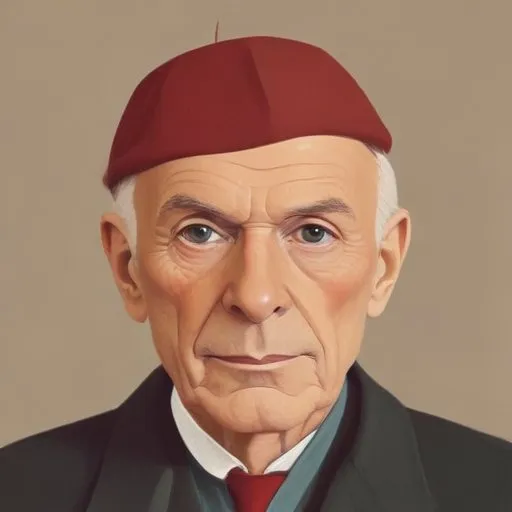
Austrian painter and sculptor known for surreal and fantastical works that blend dreamlike imagery with vivid colors, often exploring themes of identity and the human condition.
Rudolf Hausner, an Austrian painter, draughtsman, printmaker, and sculptor, is renowned for being the first psychoanalytical painter, earning him the title of "psychic realist." His unique style, which merged the principles of psychoanalysis with art, continues to intrigue art enthusiasts and scholars alike.
Born on December 4, 1914, in Vienna, Austria, Hausner grew up in a family with a strong appreciation for art. His father, a commercial employee, was a Sunday painter, which sparked Hausner's enthusiasm for art from an early age. Hausner attended the Schubert Realschule and later the Realgymnasium Schottenbastei in Vienna, where he developed his artistic skills.
From 1931 to 1936, Hausner studied at the Academy of Fine Arts in Vienna under the guidance of Carl Fahringer and Karl Sterrer. This period played a significant role in shaping his artistic style and ideology.
Hausner's artistic career was marked by several milestones, including his founding of a surrealist group in 1946, alongside fellow artists Edgar Jen, Ernst Fuchs, and others. This group aimed to promote surrealist art in Austria, and their efforts led to the organization of several exhibitions.
One of his most notable works, "It's me" (1948), is a testament to his unique style, which blended elements of Pittura Metafisica and surrealism with psychoanalytical principles. This painting showcases his ability to create thought-provoking art that explores the human psyche.
Hausner's artistic philosophy was deeply rooted in psychoanalytical principles, which he believed could be applied to art. He sought to create art that not only reflected the human psyche but also explored the subconscious mind. His work was a reflection of his fascination with the human psyche and its mysteries.
In 1937, Hausner was drafted into the Austrian Armed Forces, and later, in 1941, he was drafted into the German Armed Forces. During his time in the military, he had a formative traumatic experience in the Russian Tatra Mountains, which later influenced his artwork.
In 1944, Hausner married Irene Schmied, and after the war, he returned to his studio in Vienna, resuming his work as an artist. He continued to create art that was both thought-provoking and visually stunning.
Hausner's unique style and artistic philosophy have had a significant impact on modern art. His application of psychoanalytical principles to art has inspired a new generation of artists to explore the human psyche through their work.
His influence extends beyond the art world, as his work has contributed to a greater understanding of the human psyche and its complexities. Hausner's art has also encouraged people to explore their own subconscious minds, leading to a deeper understanding of themselves and their surroundings.
Rudolf Hausner's legacy is a testament to his innovative approach to art. He has left behind a body of work that continues to inspire and intrigue art enthusiasts and scholars alike. His pioneering work in the field of psychic realism has paved the way for future generations of artists to explore new and innovative ways of expressing themselves.
Hausner's lifetime achievements are a reflection of his dedication to his craft and his passion for exploring the human psyche. His work will continue to be celebrated for generations to come, inspiring others to push the boundaries of art and explore the unknown.
Born in 1890
Austrian soldier and painter who captured the intensity of human emotion through bold, expressive portraits and landscapes, often exploring themes of death, sexuality, and the human condition.
Born in 1862
Austrian Symbolist master of opulent, gold-leaf adorned paintings and illustrations that explored the human form, often with erotic undertones. His works are synonymous with Viennese Art Nouveau.
Born in 1886
Austrian-Swiss artist who pioneered Expressionism through vibrant, emotive paintings and plays that explored the human condition. His works often featured distorted forms and bold colors.
Born in 1877
Austrian author and illustrator of fantastical and often unsettling stories, known for his pioneering work in the field of fantastical literature and his eerie, dreamlike illustrations.
Born in 1880
A German soldier-turned-painter who pioneered Expressionism, capturing the emotional essence of animals and landscapes in vibrant, abstracted forms. His work continues to inspire artists and art lovers alike.
Born in 1887
A pioneering expressionist painter who captured the vibrant spirit of early 20th-century Europe through bold, colorful works that blended Fauvism and Cubism. His innovative style continues to inspire artists today.
Born in 1866
A pioneer of abstract art, creating vibrant, expressive works that explored the emotional and spiritual properties of color, and wrote extensively on art theory.
Born in 1879
A Swiss-German artist and educator who blended fantasy and reality in his vibrant, whimsical paintings, exploring the emotional and expressive qualities of color. His unique style has inspired generations of artists.
