


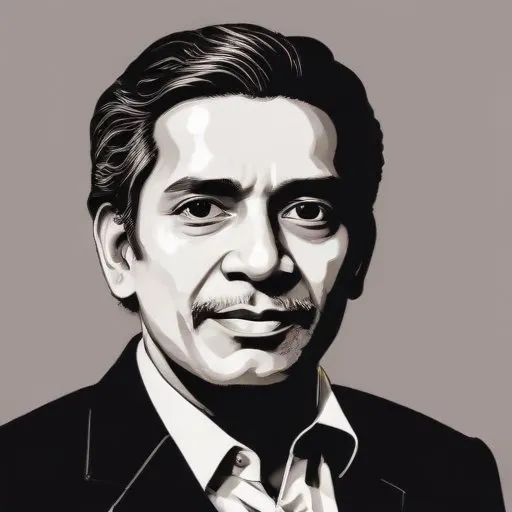
A Sri Lankan journalist and author who wrote extensively on the Sri Lankan Civil War and its impact on the Tamil minority, shedding light on human rights abuses and advocating for their rights.
S. Sivanayagam, a renowned Sri Lankan journalist, author, and editor, is best known for his fearless reporting and outspoken views on the Sri Lankan conflict, particularly during the tumultuous 1980s. Throughout his career, he edited several prominent publications, including the Saturday Review, Tamil Nation, and Hot Spring, earning him a reputation as a champion of free speech and journalistic integrity.
Sivanayagam was born on September 7, 1930, in Kokkuvil, northern Ceylon, to Sattanathar Subramaniam and Kanmaniammal. He received his education at Kokkuvil Hindu College and Jaffna College, before joining Ceylon Law College, although he didn't complete the course.
Sivanayagam's journalistic career spanned over four decades, during which he worked for several prominent publications. He began his career at the Ceylon Daily News in 1953, later writing a column for The Times of Ceylon. He also worked for the Daily Mirror (1961-1969) and the Ceylon Tourist Board.
In 1982, he became the first editor of the Saturday Review, where he fearlessly reported on the escalating Sri Lankan conflict. After the Black July riots of 1983, the Sri Lankan government banned the Saturday Review, and Sivanayagam was forced to flee to Madras, India, where he established the Tamil Information Centre and Tamil Information and Research Institute.
In 1990, Sivanayagam became the editor of Tamil Nation, a journal that continued to voice his concerns about the Sri Lankan conflict. However, after the assassination of Rajiv Gandhi in 1991, he was arrested under the National Security Act and imprisoned without charge. He was subjected to physical and mental torture while in prison.
After his release, Sivanayagam sought asylum in France in 1993, where he founded and edited the Hot Spring journal. He later moved to London, where he wrote two books, The Pen and the Gun (2001) and Sri Lanka: Witness to History - A Journalist's Memoirs (2005).
S. Sivanayagam's bravery and commitment to journalistic integrity have inspired generations of journalists and writers. His unwavering stance against oppression and his determination to report the truth, even in the face of immense danger, have earned him a place among the most respected journalists of his time.
Through his work, Sivanayagam has left an indelible mark on the world of journalism, and his legacy continues to inspire and motivate those who value freedom of speech and the pursuit of truth.
68 Years Old
A fearless journalist and lawyer who exposed government corruption and human rights abuses in Sri Lanka, ultimately paying the ultimate price for his courage.
77 Years Old
The 8th president of Sri Lanka is a former military officer who led a crackdown on the Tamil Tigers, ending a decades-long civil war, and later became a populist leader. He's known for his strong nationalist stance and controversial human rights record.
80 Years Old
A Sri Lankan lawyer and politician who served as the 6th President of Sri Lanka, known for his role in ending the country's 26-year civil war. He's also infamous for alleged human rights abuses during his tenure.
77 Years Old
The 13th Prime Minister of Sri Lanka, a seasoned lawyer and politician, led the country through significant economic and political reforms, earning him a reputation as a champion of democracy and development.
81 Years Old
A pioneering female leader who served as Sri Lanka's first female President, known for her efforts to bring peace and reconciliation to the war-torn nation. She implemented policies to promote economic development and social welfare.
Born in 1906
A Sri Lankan lawyer and politician who served as the 2nd President of Sri Lanka, known for introducing a new constitution and establishing a presidential system of government. He's also credited with opening up the country's economy and promoting market-oriented reforms.
Born in 1899
A lawyer-turned-politician who championed Sinhalese nationalism and led Sri Lanka towards self-sufficiency, introducing sweeping reforms in education, agriculture, and industry. He's remembered for his bold, if sometimes divisive, leadership.
