


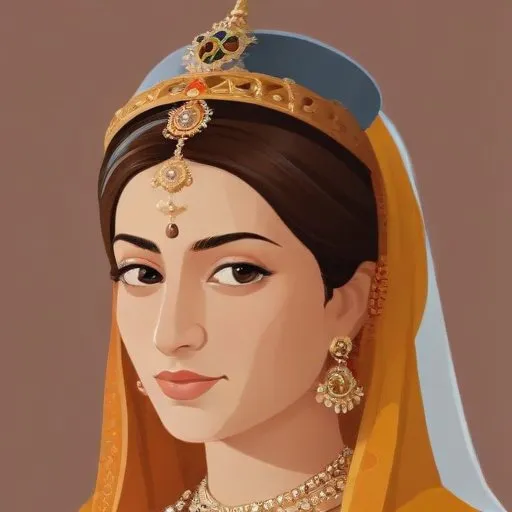
The Empress of the Mughal Empire was a powerful and influential queen who played a crucial role in shaping the empire's politics and architecture, leaving a lasting legacy in Indian history. She was a patron of the arts and commissioned several iconic buildings, including the Taj Mahal.
Salima Sultan Begum, a prominent figure in the Mughal Empire, is renowned for her significant influence on the reigns of two notable emperors, Akbar and Jahangir. She was not only a queen but also a poet, a reader, and a wise counsel, earning her the title "Khadijauz-Zamani" or "Khadija of the Age" for her wisdom.
Salima Sultan Begum was born on February 23, 1539, to Gulrukh Begum, a Mughal princess, and Nuruddin Muhammad Mirza, the Viceroy of Kannauj. Initially betrothed to Bairam Khan, a regent of Akbar, she married him in 1557. However, their union was short-lived, ending with Bairam's assassination in 1561. Subsequently, she married her first cousin, Akbar, and became his chief consort.
Salima Sultan Begum played a crucial role in the Mughal court, wielding significant political influence during Akbar's reign and beyond. She was entrusted with the charge of the Muslim harem and was known for her diplomatic skills, often mediating between Akbar and his son, Jahangir. Her influence extended to Jahangir's reign, where she continued to play a vital role in shaping the empire's policies.
Salima Sultan Begum was a skilled poet and writer, adopting the pseudonym "Makhfi" or "The Hidden One." Her literary contributions remain an essential part of her legacy, showcasing her intellectual and creative prowess.
Although Salima Sultan Begum did not have children of her own, she raised Murad Mirza, Akbar's second son, for the first few years. Her family lineage was marked by her connection to the illustrious Naqshbandi Khwajas, a respected and esteemed family in the Mughal Empire.
Salima Sultan Begum's impact on the Mughal Empire was profound, with her influence extending beyond the reigns of Akbar and Jahangir. She remains an iconic figure in Indian history, celebrated for her wisdom, literary pursuits, and political acumen.
Salima Sultan Begum's life and achievements serve as a poignant reminder of the immense power and influence women wielded in the Mughal Empire, leaving an indelible mark on Indian history.
Born in 1542
The Mughal emperor who ruled India from 1556 to 1605, known for his military campaigns, administrative reforms, and cultural achievements, including the construction of the Taj Mahal. He was a patron of the arts and a tolerant ruler, fostering a period of cultural and religious harmony.
Born in 1569
The fourth Mughal emperor, known for his tolerant and artistic reign, patronizing arts and architecture, and expanding the empire through strategic military campaigns.
Born in 1592
The fifth Mughal emperor, who built the iconic Taj Mahal as a mausoleum for his beloved wife, and expanded the empire through military campaigns and architectural achievements.
Born in 1593
The beloved wife of Mughal Emperor Shah Jahan, buried in the stunning white marble mausoleum she inspired, a testament to eternal love and architectural innovation.
Born in 1577
The powerful empress who ruled alongside her husband, Jahangir, and was a skilled diplomat, strategist, and patron of the arts, known for her remarkable administrative and military prowess. She was a true partner in power, making key decisions and even leading troops into battle.
Born in 1483
The founder of the Mughal Empire, a powerful and culturally rich dynasty that ruled much of India and Pakistan for centuries, known for his military conquests and patronage of the arts.
Born in 1540
A 16th-century Rajput king who fought against the Mughal Empire, known for his bravery and resistance against foreign rule. He is celebrated as a hero in Indian history.
