


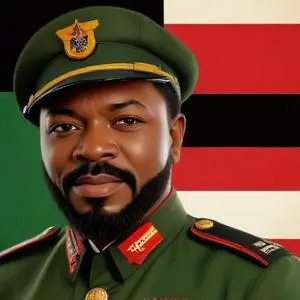
Led Mozambique to independence from Portugal in 1975 and served as its first president, implementing socialist policies and promoting African unity. He's also known for his role in the fight against apartheid in South Africa.
Samora Machel, the first President of Mozambique, is renowned for leading the country to independence from Portuguese colonial rule in 1975, and for his unwavering commitment to Marxist-Leninist ideology. As a charismatic military commander and political leader, Machel played a pivotal role in shaping Mozambique's destiny, earning him a revered place in the annals of African history.
Born on September 29, 1933, in the village of Madragoa, Gaza Province, Mozambique, Machel grew up in a family of farmers. His grandfather had collaborated with Gungunhana, a prominent Mozambican leader, which instilled in him a sense of national pride and resistance to colonial rule. Under Portuguese rule, Machel's father was subjected to discriminatory treatment, forced to accept lower prices for his crops and compelled to grow labor-intensive cotton, which took time away from food crops. These experiences would later shape Machel's anti-colonial sentiments and inform his revolutionary ideology.
In the 1950s, Machel began studying nursing in Loureno Marques (now Maputo), where he became increasingly politicized and joined the Mozambican African National Union (MANU), a liberation movement. He later formed the Mozambican Liberation Front (FRELIMO), which would become the leading force in the fight for independence. Machel's charisma, strategic thinking, and military prowess earned him the respect and admiration of his comrades, who elected him as the leader of FRELIMO in 1969.
In 1975, Mozambique gained independence, and Machel became the country's first President. He implemented a Marxist-Leninist system, introducing nationalizations, land reforms, and a planned economy. His government prioritized education, healthcare, and rural development, aiming to eradicate the legacy of colonialism and promote social equality. Machel's revolutionary fervor and commitment to socialism earned him the admiration of international leaders, including Cuba's Fidel Castro and the Soviet Union's Leonid Brezhnev.
On October 19, 1986, Samora Machel's life was tragically cut short when his presidential aircraft crashed near the Mozambican-South African border. The circumstances surrounding his death remain shrouded in mystery, with suspicions of sabotage and assassination. Machel's untimely demise was met with an outpouring of grief across Mozambique and the international community, mourning the loss of a visionary leader who had inspired a generation of Africans.
Machel's philosophical outlook was shaped by his commitment to Marxist-Leninist ideology, which he saw as a means to achieve social justice and national liberation. He believed in the importance of collective leadership, grassroots participation, and the empowerment of the working class. Machel's vision for a socialist Mozambique was underpinned by his faith in the transformative power of education, which he saw as a key driver of social change.
Samora Machel's legacy extends far beyond Mozambique's borders. He inspired a generation of African leaders, including Nelson Mandela, who often sought his counsel. Machel's commitment to pan-Africanism, socialism, and anti-imperialism continues to resonate with progressive movements worldwide. His emphasis on education, healthcare, and rural development has informed development policies across Africa, cementing his status as a champion of human dignity and social justice.
"The emancipation of women is not an act of charity, but an act of justice."
"We will not rest until the last vestiges of colonialism and imperialism have been eradicated from our continent."
"Education is the most powerful weapon which can be used to change the world."
Samora Machel's life and leadership are inextricably linked to the broader struggle for African independence and self-determination. His commitment to socialism, pan-Africanism, and anti-imperialism continues to inspire movements and leaders worldwide. As a champion of human dignity and social justice, Machel's legacy serves as a beacon of hope for a more equitable and just world.
Born in 1918
A South African lawyer and politician who fought against apartheid, becoming the country's first black president and a symbol of racial reconciliation, earning a Nobel Peace Prize. He's a beacon of hope and freedom.
Born in 1922
First President of Tanzania, led the country to independence from British colonial rule and implemented socialist policies, known for his Pan-Africanism and anti-colonialism efforts.
Born in 1924
First president of Zambia, leading the country to independence from British colonial rule and advocating for African unity and development.
Born in 1924
The 2nd President of Zimbabwe, a controversial figure who ruled with an iron fist, known for his country's economic downfall and human rights abuses.
Born in 1922
Angola's first president and a celebrated poet, he led the country to independence from Portugal and is revered for his nationalistic and literary contributions.
Born in 1924
African revolutionary and founder of Guinea-Bissau, leading the country to independence from Portugal through a decade-long guerrilla war. He's revered for his pan-Africanist vision and anti-colonial leadership.
Born in 1922
First President of Guinea, led country to independence from France in 1958, and implemented socialist policies. Known for his Pan-Africanism and anti-colonial stance.
