


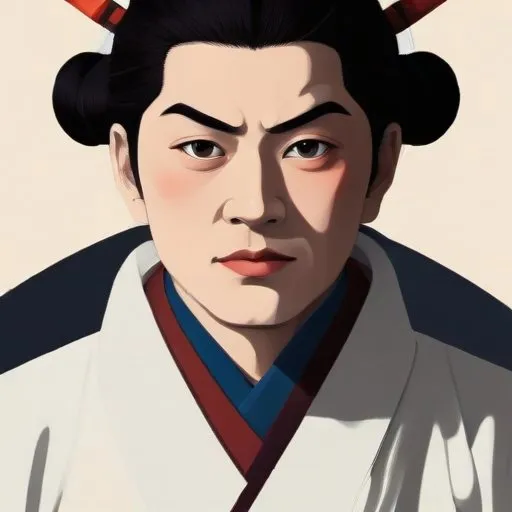
A 17th-century Japanese feudal lord who ruled the Satsuma Domain and played a key role in the country's unification, known for his military prowess and strategic alliances.
Shimazu Tadatsune, a renowned tozama daimyo of Satsuma, holds a significant place in Japanese history for being the first to rule over the Ryukyu Kingdom and his exceptional leadership during the Tokugawa shogunate. His remarkable achievements, strategic alliances, and innovative governance earned him a reputation as one of the most powerful lords in Japan during his time.
Born on November 27, 1576, Tadatsune was the third son of Shimazu Yoshihiro, a prominent daimyo. Following the death of his uncle, Shimazu Hisakazu, and the lack of an heir from his elder brother, Shimazu Yoshihisa, Tadatsune became the chosen successor to lead the Shimazu clan.
Tadatsune demonstrated exceptional bravery on the battlefield, inheriting the trait from his father and uncle. During the second half of Hideyoshi's invasions of Korea, he fought alongside his father and helped defeat the Ming army of over 100,000 men with only 8,000 men, showcasing his tactical prowess.
As the head of the Shimazu clan, Tadatsune sought to reform the clan leadership and eliminate corrupt or disloyal counselors. In 1599, he took drastic measures by killing Ijuin Tadamune, a longtime retainer, and his son, Ijuin Tadazane, when they attempted to part ways with the Shimazu clan. This bold move demonstrated his commitment to strengthening the clan's unity and stability.
On April 5, 1609, Tadatsune led an expeditionary force to the Ryukyu Kingdom, successfully subjugating it and establishing a strategic trade route with China. The Ryukyu Kingdom was allowed to maintain semi-independence, avoiding formal annexation by Japan until the Meiji Restoration in 1868. This unique arrangement enabled Japan to maintain trade relations with China, as direct Chinese knowledge of Japanese control would have led to trade cessation.
Tadatsune's visionary leadership and innovative governance policies paved the way for Japan's future growth and development. His strategic alliances, military prowess, and commitment to reform have left a lasting impact on Japanese history. His legacy continues to inspire and influence generations, solidifying his position as one of the most esteemed daimyos of all time.
Shimazu Tadatsune's remarkable life and achievements serve as a testament to his exceptional leadership and vision, making him an integral part of Japanese history.
Born in 1543
Unified Japan's warring states, establishing a dynasty that ruled for over 250 years, and is revered as a brilliant military strategist and statesman.
Born in 1579
The second shogun of the Tokugawa dynasty, who solidified the family's rule and established a rigid feudal system in Japan, known for his military campaigns and administrative reforms.
Born in 1604
The shogun who ruled Japan from 1623 to 1651, known for isolating Japan from the rest of the world and establishing a rigid feudal system.
Born in 1530
A powerful feudal lord who unified Japan's Echigo Province and fought several battles, earning a legendary reputation for bravery and martial prowess.
Born in 1521
A powerful daimy? who unified Japan's Takeda clan and expanded its territories through military campaigns, known for his exceptional leadership and innovative tactics.
Born in 1567
A powerful feudal lord who unified Japan's northern regions and was known for his distinctive crescent-moon helmet and military prowess. He played a crucial role in Japan's unification under the Tokugawa shogunate.
