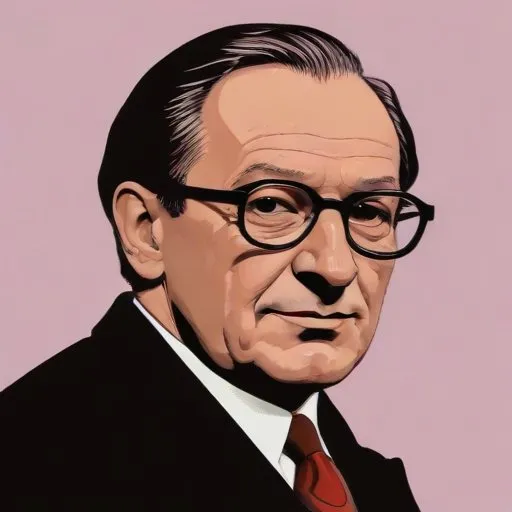
Sidney Hook: The Pragmatic Philosopher Who Critiqued Totalitarianism
A Radical Thinker with a Shift in Perspective
Sidney Hook, a prominent American philosopher, is renowned for his significant contributions to the philosophy of history, education, political theory, and ethics. He is particularly notable for his critiques of totalitarianism, both fascist and Marxist-Leninist ideologies.
Early Life and Education
Born on December 20, 1902, in Brooklyn, New York City, to Austrian Jewish immigrants Jennie and Isaac Hook, Sidney's intellectual curiosity was sparked at a young age. He supported the Socialist Party of America during his high school days and went on to earn his BA from the City College of New York in 1923. He then pursued his Ph.D. at Columbia University under the guidance of pragmatist philosopher
John Dewey, completing it in 1927.
Career and Academic Pursuits
Hook's academic career began in 1926 as a professor of philosophy at New York University, where he headed the Department of Philosophy from 1948 to 1969. He also taught at the New School for Social Research from 1931 to 1936 and later taught night school until the 1960s. His involvement with the American Civil Liberties Union's (ACLU) academic freedom committee, alongside colleague Horace M. Kallen, started in 1933.
From Marxism to Critique of Totalitarianism
Initially, Hook was an expert on
Karl Marx's philosophy and an ardent Marxist himself. He attended Karl Korsch's lectures in Berlin in 1928 and conducted research at the Marx-Engels Institute in Moscow in the summer of 1929. However, after witnessing the harsh realities of totalitarian regimes, Hook shifted his stance and became a vocal critic of both fascist and Marxist-Leninist ideologies.
Philosophical Contributions and Beliefs
Hook's philosophical contributions are marked by his rejection of totalitarianism and his commitment to social democracy. He argued that members of groups like the Communist Party USA and Leninists, who advocated for the violent overthrow of democratic governments, could be ethically barred from holding public offices of trust. This stance was rooted in his belief that democratic values and individual freedoms should be protected from authoritarian threats.
Personal Milestones and Key Life Events
- Hook retired from New York University in 1972.
- He was a frequent contributor to publications like The New York Times and The Nation.
- Hook's work was recognized through various awards and honors, including the Presidential Medal of Freedom in 1985.
Influence on Modern Society
Sidney Hook's work has had a lasting impact on contemporary political thought. His critiques of totalitarianism continue to resonate in today's society, serving as a warning against the dangers of authoritarianism and the importance of protecting democratic values.
Legacy and Historical Context
Hook's legacy is a testament to the power of critical thinking and intellectual honesty. His shift from Marxism to a critique of totalitarianism demonstrates the importance of reassessing one's beliefs in light of new evidence and experiences. As a philosopher, educator, and public intellectual, Sidney Hook's work continues to inspire and educate generations to come.
FAQ
What were Sidney Hooks contributions to Marxist philosophy?
Sidney Hook made significant contributions to Marxist philosophy, critiquing the ideology and developing his own brand of democratic socialism.
What was Sidney Hooks role in the American Academy of Arts and Letters?
Sidney Hook was an active member of the American Academy of Arts and Letters, serving as its president from 1964 to 1965.
What were Sidney Hooks views on civil liberties?
Sidney Hook was a strong advocate for civil liberties, speaking out against McCarthyism and supporting the American Civil Liberties Union.
What was Sidney Hooks relationship with other philosophers?
Sidney Hook was friends with many prominent philosophers of his time, including John Dewey and Ernest Nagel.
What is Sidney Hooks legacy in American intellectual history?
Sidney Hooks legacy in American intellectual history is as a prominent philosopher, critic, and public intellectual who shaped the countrys intellectual discourse.