


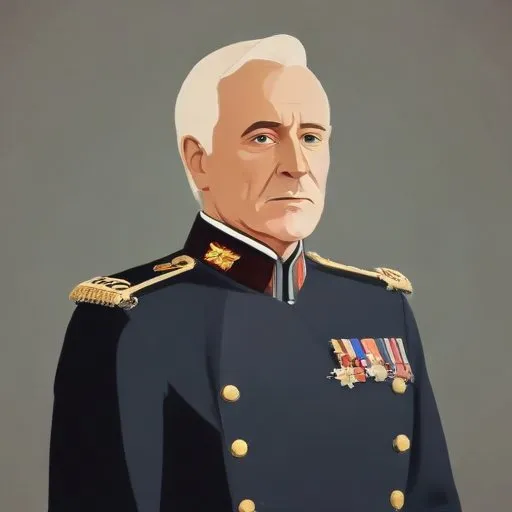
A high-ranking German officer who served as the Chief of the Medical Services of the German Armed Forces during World War II, known for his involvement in medical war crimes and atrocities.
Siegfried Handloser, a name synonymous with the darkest corners of medical history, is known for overseeing some of the most heinous medical atrocities committed during World War II. As the Chief of the Medical Services of the Wehrmacht, Handloser was instrumental in perpetuating the Nazi regime's brutal experiments on concentration camp prisoners.
Handloser's journey to infamy began in 1937, when he joined the committee of the German Society for Internal Medicine as a de facto Nazi emissary. His loyalty to the party and his medical expertise quickly propelled him up the ranks, and by 1938, he had become the Army Group physician of the Nazi Army Group Command 3. In 1939, he was named an honorary professor, solidifying his position as a respected and influential figure in the medical community.
But it was Handloser's role in orchestrating human experiments at Buchenwald concentration camp that would earn him a permanent place in the annals of war criminality. On December 29, 1941, he attended a meeting where the decision was made to test typhus vaccines on camp prisoners, resulting in the deaths of approximately 100 people. Handloser's complicity in these atrocities would ultimately lead to his conviction at the 1947 Doctors Trial.
As the Chief of the Medical Services of the Wehrmacht, Handloser oversaw the organization of forced prostitution in occupied territories, with the goal of minimizing venereal disease and preventing sexual intercourse with Jewish women. His role was instrumental in perpetuating the Nazi regime's brutal and inhumane policies.
In August 1947, Handloser was convicted by the American Military Tribunal No. 1 and sentenced to life imprisonment. However, in 1954, his sentence was reduced to 20 years, and he was released shortly before dying of cancer in Munich at the age of 69.
Siegfried Handloser's name is etched in the consciousness of humanity as a symbol of the darkest corners of medical history. His legacy serves as a stark reminder of the dangers of unchecked power and the importance of upholding the highest ethical standards in the pursuit of medical knowledge.
Handloser's actions and beliefs were shaped by his unwavering loyalty to the Nazi party and its ideology. His complicity in the regime's atrocities is a testament to the dangers of blind obedience and the importance of upholding human dignity above all else.
Siegfried Handloser's crimes serve as a stark reminder of the importance of ethical standards in medical research and the dangers of unchecked power. His legacy has led to a renewed focus on upholding human rights and dignity in the pursuit of medical knowledge.
Born in 1889
The dictator of Nazi Germany, responsible for the genocide of six million Jews and millions of other people during World War II, and infamous for his extreme nationalist and anti-Semitic ideology.
Born in 1900
Leading the SS and Gestapo, he oversaw the Nazi regime's brutal security apparatus and implemented the "Final Solution," orchestrating the genocide of six million Jews during World War II.
Born in 1893
A high-ranking Nazi official, he was a decorated World War I fighter pilot and later became a prominent politician, serving as Minister President of Prussia. He's infamous for his role in the Nazi regime and war crimes trials.
Born in 1897
A mastermind of Nazi propaganda, he crafted a persuasive narrative that fueled the Third Reich's rise to power, leaving a lasting impact on the world.
Born in 1876
A German naval leader who played a key role in the Kriegsmarine during World War II, overseeing the German U-boat fleet and naval operations. He was a close advisor to Adolf Hitler and implemented the German naval strategy during the war.
Born in 1891
A German naval commander who led the U-boat fleet during World War II and briefly served as President of Germany after Hitler's death, known for his role in the war and its aftermath.
Born in 1882
A high-ranking Nazi officer who served as the Chief of the OKW, the German High Command, during World War II, and was known for his unwavering loyalty to Hitler. He was tried and executed for war crimes after the war.
Born in 1890
Chief of the German High Command during World War II, responsible for planning and executing military operations, and signing the unconditional surrender of Germany.
