


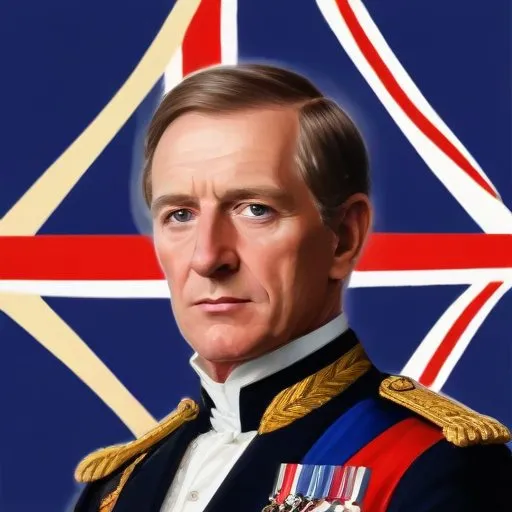
A British general and politician who served as the 3rd Governor-General of New Zealand, known for his military and administrative leadership in the early 20th century.
Sir Charles Fergusson, 7th Baronet, is best known for his illustrious career as a British Army officer and his tenure as the third Governor-General of New Zealand from 1924 to 1930. During his term, he played a significant role in shaping the country's history, earning him a notable place in the annals of New Zealand's governance.
Born on January 17, 1865, Fergusson was the son of Sir James Fergusson, 6th Baronet, who later became the 6th Governor of New Zealand. This familial connection with New Zealand would eventually come full circle when Fergusson took up the role of Governor-General himself.
Fergusson's military career began at Eton College, followed by the Royal Military College, Sandhurst. He was commissioned into the Grenadier Guards in November 1883 and went on to serve in Sudan from 1896 to 1898. During this period, he rose through the ranks, becoming Commanding Officer of the 15th Sudanese Regiment in 1899 and Commander of the Omdurman District in 1900.
Fergusson's military prowess earned him the position of Adjutant General of the Egyptian Army in early 1901. He continued to climb the ranks, becoming Commanding Officer of 3rd Battalion Grenadier Guards in 1904 and a Brigadier-General on the staff of the Irish Command in 1907.
In 1913, he was appointed General Officer Commanding (GOC) of the 5th Division in Ireland, where he played a crucial role during the Curragh incident, ensuring his officers obeyed orders. At the outbreak of World War I, he took the 5th Division to France and later commanded II Corps and XVII Corps, leading the latter until the end of the war in November 1918.
After retiring from the army in 1922, Fergusson was appointed Governor-General of New Zealand in 1924, a position his father had held previously. During his tenure, he worked closely with Prime Ministers William Massey and Gordon Coates, focusing on issues like taxation, education, and Māori welfare.
Fergusson's governor-generalship was marked by significant events, including the country's involvement in the British Empire Exhibition in 1924 and the New Zealand Centennial Exhibition in 1930. He also oversaw the establishment of the New Zealand Parliament's Māori Affairs Committee.
Fergusson's personal milestones include his marriage to Lady Alice Mary Boyle in 1901 and the birth of their three children. His son, Lord Ballantrae, would later become the tenth and last British-appointed Governor-General of New Zealand.
Sir Charles Fergusson, 7th Baronet, passed away on February 20, 1951, leaving behind a legacy as a distinguished military leader and a significant figure in New Zealand's history. His contributions to the country's development and growth continue to be celebrated to this day.
Through his remarkable life and career, Sir Charles Fergusson, 7th Baronet, demonstrated unwavering dedication to duty, leadership, and public service, earning him a revered place in the history books.
Born in 1865
The second monarch of the House of Windsor, reigning from 1910 to 1936, known for leading the British Empire through World War I and modernizing the monarchy.
Born in 1865
The second monarch of the House of Windsor, reigning from 1910 to 1936, known for leading the British Empire through World War I and modernizing the monarchy.
Born in 1871
Prolific writer of historical novels and adventure stories, also a talented landscape painter.
Born in 1867
A conservative leader who served as Prime Minister three times, known for his role in navigating Britain through economic crises and advocating for imperial protectionism.
Born in 1866
A Scottish journalist and politician who served as the first Labour Party Prime Minister of the United Kingdom, leading the country through significant economic and social reforms. He is also known for his efforts to maintain peace in Europe during the interwar period.
Born in 1897
A British politician who served as Prime Minister from 1955 to 1957, known for his role in the Suez Crisis and his diplomatic efforts during the Cold War.
Born in 1883
Led the Labour Party to a landslide victory in 1945, implementing significant social and economic reforms, including the creation of the National Health Service. He played a crucial role in shaping post-war Britain.
