


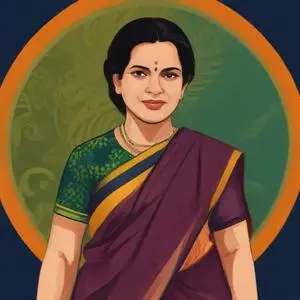
The world's first female prime minister, who broke gender barriers in politics and led her country through a tumultuous period of economic and social change. She paved the way for future generations of female leaders.
Sirimavo Bandaranaike was a pioneering Sri Lankan politician who made history by becoming the world's first female prime minister in 1960. This remarkable woman led her country through three terms, implementing reforms and championing the causes of women, rural communities, and the marginalized.
Born on April 17, 1916, into a Sinhalese Kandyan aristocratic family, Bandaranaike was educated in Catholic schools, where she developed a strong sense of social responsibility. She worked on various social programs before marrying and raising a family with S.W.R.D. Bandaranaike, the founder of the Sri Lanka Freedom Party (SLFP).
As the First Lady of Sri Lanka, Bandaranaike played a crucial role in supporting her husband's political career, earning his trust as an informal advisor. Her social work focused on improving the lives of women and girls in rural areas, laying the foundation for her future leadership.
Following her husband's assassination in 1959, Bandaranaike was persuaded by the SLFP leadership to enter politics and succeed her husband as party chairwoman. She led the party to victory in the 1960 election, becoming the world's first female prime minister.
During her three terms in office (1960-1965, 1970-1977, and 1994-2000), Bandaranaike implemented significant reforms, including the nationalization of key industries, expansion of education and healthcare, and empowerment of women. Her leadership style was marked by pragmatism, compassion, and a commitment to social justice.
Bandaranaike's political philosophy was rooted in Buddhism and socialism. She believed in the importance of equitable distribution of wealth and resources, and worked towards creating a more just and equal society.
Her vision for Sri Lanka was that of a socialist republic, where the state played a key role in promoting economic development and social welfare. This vision guided her policy decisions and shaped her leadership style.
Sirimavo Bandaranaike's legacy extends beyond her impressive political achievements. She paved the way for future generations of women in politics, inspiring countless leaders around the world.
Her commitment to social justice, education, and women's empowerment has had a lasting impact on Sri Lankan society. Today, she is remembered as a pioneering leader who broke down barriers and challenged stereotypes.
"I have always believed that politics should be for the people, not for personal gain. I have always stood for what I believe in, even if it meant standing alone."
These words, spoken by Sirimavo Bandaranaike, reflect her unwavering commitment to her principles and her people.
Bandaranaike received numerous awards and honors for her contributions to politics, social justice, and women's empowerment. Some notable awards include:
Sirimavo Bandaranaike's remarkable life and legacy continue to inspire leaders and citizens around the world. Her commitment to social justice, education, and women's empowerment has left an indelible mark on Sri Lankan history.
Sirimavo Bandaranaike was a trailblazing leader who broke down barriers and challenged stereotypes. Her remarkable life and legacy serve as a testament to the power of determination, compassion, and visionary leadership. She will always be remembered as a champion of social justice and a beacon of hope for generations to come.
81 Years Old
A pioneering female leader who served as Sri Lanka's first female President, known for her efforts to bring peace and reconciliation to the war-torn nation. She implemented policies to promote economic development and social welfare.
80 Years Old
A Sri Lankan lawyer and politician who served as the 6th President of Sri Lanka, known for his role in ending the country's 26-year civil war. He's also infamous for alleged human rights abuses during his tenure.
Born in 1906
A Sri Lankan lawyer and politician who served as the 2nd President of Sri Lanka, known for introducing a new constitution and establishing a presidential system of government. He's also credited with opening up the country's economy and promoting market-oriented reforms.
Born in 1899
A lawyer-turned-politician who championed Sinhalese nationalism and led Sri Lanka towards self-sufficiency, introducing sweeping reforms in education, agriculture, and industry. He's remembered for his bold, if sometimes divisive, leadership.
