


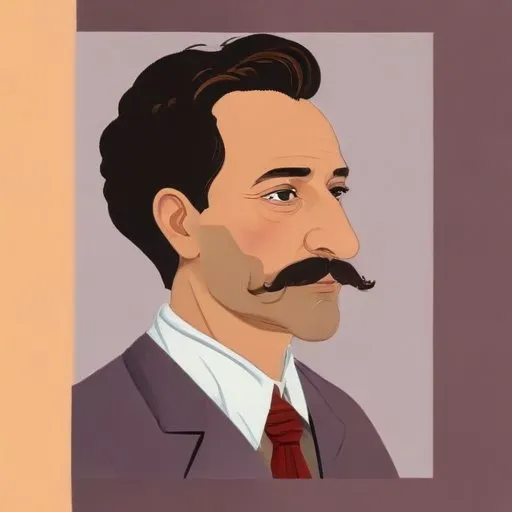
A Hungarian poet and author celebrated for his innovative and eclectic style, blending elements of surrealism, futurism, and folk traditions. He's revered for his unique, imaginative, and often provocative works that defy categorization.
Sndor Weres, a Hungarian poet and author, is renowned for his prolific translations of world literature into Hungarian, including the works of Ukrainian poet Taras Shevchenko, Georgian poet Rustaveli, and Indian poet Jai Dev. His translations have had a profound impact on Hungarian literature, introducing readers to a wide range of international voices and styles.
Weres was born on June 22, 1913, in Szombathely, Hungary, and spent his formative years in the nearby village of Csnge. His literary talent was evident from an early age, with his first poems published in the influential journal Nyugat (West) when he was just 14 years old.
Weres pursued higher education at the University of Pcs, initially studying law before shifting his focus to geography and history. He ultimately earned a doctorate in philosophy and aesthetics, with his dissertation, "The Birth of the Poem," published in 1939.
In 1937, Weres embarked on his first trip abroad, attending a Eucharistic Congress in Manila and subsequently visiting Vietnam and India. These experiences had a profound impact on his writing, exposing him to diverse cultures and literary traditions.
During World War II, Weres was drafted for compulsory labor but avoided front-line duty. In the post-war period, he returned to Csnge and briefly worked as a farmer before setting off on another journey, this time to Italy, where he lived from 1948 to 1949.
Weres's translation work was incredibly diverse, with notable examples including:
Weres's translation of the Tao Te Ching remains the most widely read version in Hungary to this day.
Weres received numerous accolades for his contributions to Hungarian literature, including the Kossuth Prize, one of Hungary's highest honors.
During the Stalinist era in Hungary, Weres's work was largely silenced, with little of his writing published between 1948 and 1964. Despite these challenges, he continued to write and translate, settling in Budapest in 1951, where he would reside for the rest of his life.
Sndor Weres's legacy extends far beyond his own writing. His translations have introduced Hungarian readers to a wealth of international literature, enriching the country's cultural landscape. Many of his poems have been set to music, with notable examples including Zoltn Kodly's choral piece, "Régiek" (Old People), and Gyrgy Ligeti's compositions.
Today, Weres is remembered as a towering figure in Hungarian literature, a poet, and translator who bridged cultures and styles, leaving behind a lasting impact on the country's literary heritage.
Born in 1905
A Hungarian poet and educator, known for his powerful and expressive works that explored themes of social justice, love, and the human condition. His poetry is celebrated for its lyricism and depth.
Born in 1885
A Hungarian literary mastermind, celebrated for his innovative, psychologically nuanced novels and poetry that probed the human condition, often with a touch of irony and humor.
Born in 1878
A Hungarian-American author and playwright renowned for his witty, satirical plays and novels that often explored the human condition, love, and social class. His works are still widely performed and adapted today.
Born in 1901
A Hungarian dentist who wrote plays and books, known for his literary works that explored themes of social justice and morality. His writings often critiqued the social norms of his time.
Born in 1886
A prominent figure in Hungarian literature, known for his lyrical poetry and translations of world classics, introducing European modernism to Hungarian readers.
